
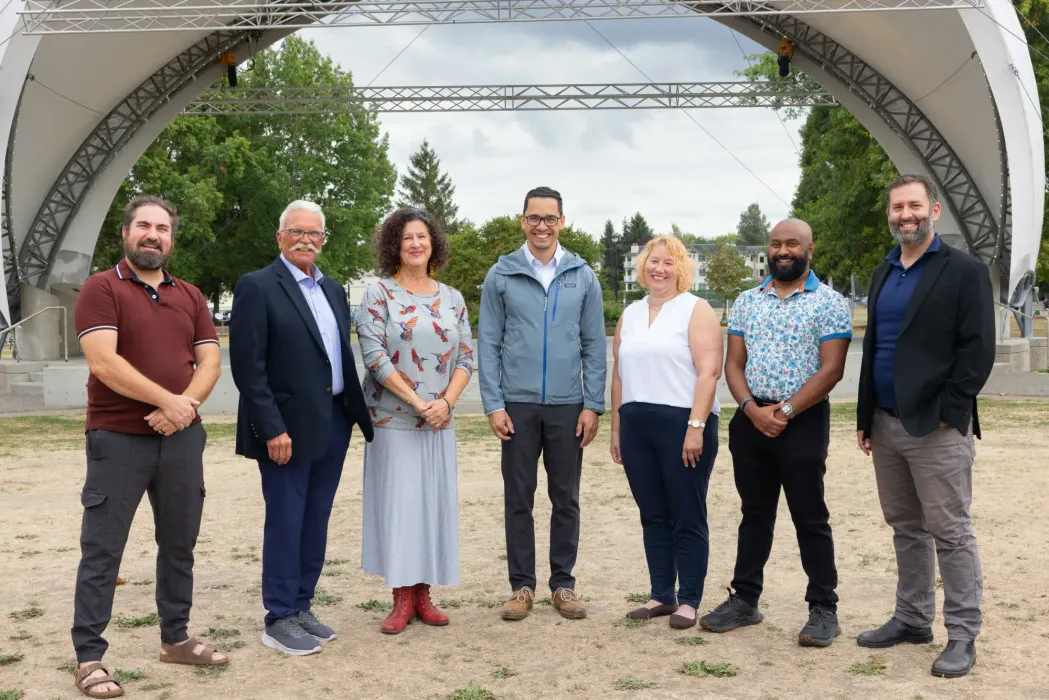
Langley City First is Mayor Nathan Pachal's slate.
Four of its candidates hold seats on the current seven-member council, and it is running seven candidates for mayor and council in the 17 October election.
It published an eight-part platform on 12 September, and it is running on a four-year record of housing, transit readiness and investment in the basics.
This profile covers the slate's candidates for mayor and council. The slate is not running school trustee candidates.
At a glance
Each point is our reading of Langley City First's policies and platform.
Under each item, ✅ marks where we think it fits our values, and ⚠️ marks a concern. A point with no concern is not an endorsement.
🏠 Housing: more homes near transit, more protection for renters.
This is the strongest part of the platform. The slate points to a BC Builds partnership for workforce rental housing, a rule requiring below-market rental homes in every new project within 800 metres of the City's two future SkyTrain stations, childcare allowed across the City, and stronger relocation support and right of return for renters whose buildings are redeveloped. Next term, it promises pre-approved home designs to speed up permits, a standards of maintenance bylaw, co-op housing advocacy and an aging-in-place strategy.
✅ This is the kind of housing policy we argue for. It ties new homes to transit, puts below-market rentals where they are needed most, and protects renters while adding supply. When higher parking minimums for non-market rentals came to a vote, all four incumbents voted them down.
🚆 Transportation: SkyTrain, roads and more ways to get around.
The slate highlights the $19 million rebuild of the Fraser Highway one-way, repaving on several streets and a new traffic light at 45A Avenue and 208 Street. Next term, it promises a seniors' shuttle to the stations, car, bike and scooter share, an e-scooter safety plan, a rail overpass on 200 Street, and continued saving toward a downtown parkade.
✅ A seniors' shuttle and shared bikes, scooters and cars all help people reach SkyTrain without owning a car.
⚠️ The one concern in this pillar is the downtown parkade, covered below.
👮 Public safety: more hires, plus prevention.
The slate says the City added nine firefighters and a fire prevention officer, going from one 24/7 fire crew to two, along with five police officers and a bylaw officer. It also launched a City emergency program and a one-stop Community Safety Department. Next term: more police, firefighters and community safety officers, volunteer ambassadors downtown and in parks, cleaner public washrooms and more park cleanups.
✅ The prevention commitments are the strongest part of this pillar. They come from residents themselves, through the Citizens' Assembly, and treat safety as something neighbours build together, not only something enforcement provides.
🌳 Parks and environment.
A new tree bylaw and urban forest strategy, dog waste collection, widened and paved trails, a new washroom at Douglas Park and upgraded fields at City Park. Next term: a climate and sustainable development framework, and wider paths across the City.
✅ Protecting the tree canopy, widening paths for people of all abilities and committing to a climate framework all line up with climate action that works for everyday residents.
🏛️ Good government.
The City's yearly transfer to its Capital Works Reserve grew from about $1 million before 2023 to more than $2 million in 2026, according to the City's financial plans. The slate says the capital budget doubled to about $30 million a year. It also moved budgeting earlier in the fall, started an outside efficiency review, launched the Let's Chat engagement platform and convened the Citizens' Assembly. Next term: an accountability dashboard and acting on the efficiency review.
✅ Saving for pipes and roads before they fail is responsible stewardship, and an accountability dashboard is a welcome step toward open government.
💼 Economic development: the Innovation District.
The term's signature plan is the Glover Road Innovation District, endorsed by council in June 2026. Developed with Kwantlen Polytechnic University, it plans for homes, jobs, plazas and walkable green streets between downtown, the future SkyTrain station and KPU's Langley campus. The slate also points to a FoodTech strategy, an online business portal and protection of industrial land. Next term: easier pop-up shops, more flexible land use for small businesses, and a small business accelerator hub.
✅ The Innovation District is the most ambitious piece of transit-oriented planning this council has produced, covered in detail below. Support for pop-ups and small local businesses keeps the economy local and gives working people a way in.
🤝 Social infrastructure.
The Resilient Neighbourhood Network that came out of the Citizens' Assembly, more community events, the outdoor pool open six months a year instead of four, a larger grant to the seniors' centre and a coordinated access program for people with complex needs. Next term: a neighbourhood house, zoning changes so more residents live within a short walk of a corner store or coffee shop, and better links to volunteer opportunities.
✅ The corner store promise is one of the best ideas in this platform. It is how neighbourhoods get less car-dependent one block at a time. A neighbourhood house and coordinated support for people in crisis reflect the same idea: a city that looks after its neighbours.
🩺 Provincial health advocacy.
The slate points to winning a provincial initiative targeting chronic property offenders in Langley, renewed federal funding for Project Black Feather, and two advocacy trips to Ottawa. Next term: more advocacy, including for more paramedics.
✅ Pushing senior governments to fund health care, paramedics and youth programs is the right fight for a small city that cannot fund them alone.
💵 Invest Langley City: two big projects, put to voters first.
Two non-binding questions on the 17 October ballot ask about a renewed Al Anderson Memorial Pool, at about $71.7 million, and an expanded Timms Community Centre with a 500-seat performing arts centre, at about $107 million. City staff published the full borrowing scenario in March, including the cost per household.
✅ Publishing the full cost before the vote, and asking residents directly, is the right way to make a decision this big.
⚠️ Our one concern is the underground parking planned for the Timms Community Centre, covered below.
🗺️ Keeping Langley City independent.
Pachal opposes amalgamation with the Township and says he will not bring forward a referendum on it.
✅ In our view, this is the right position. A small, transit-oriented City with its own fiscal profile is better served by its own council.
Other concerns
🅿️ A parkade near SkyTrain. The platform commits to keep setting aside developer payments for a future downtown parkade. The Timms Community Centre concept also includes a level of underground parking. Our concern depends mostly on price. Every underground stall is expensive to build and carry. If parking is free, taxpayers cover that cost, and a downtown about to get rapid transit ends up inviting the car trips SkyTrain is meant to replace. If parking is priced at market rates, the same parkade can pay its own way and become a useful source of City revenue, while freeing up curb space for people. The platform does not say whether the parkade would charge for parking.
🗣️ A councillor swore during a public meeting. At a council meeting in July 2026, Councillor Paul Albrecht swore while Councillor Delaney Mack had the floor. Council debate gets heated, and disagreement is healthy. Swearing while a colleague is speaking is not, and it sits poorly with a slate that has promised to cool down local politics. Albrecht later offered a public apology, which was the right thing to do. We asked Albrecht for his own account of the exchange. He did not answer individually, and the slate's response did not address it.
Like what you are reading?
The Langley Union runs with no ads, no paywalls, and no sponsored content. Only readers like you keeping it going.
Leave a one-time tipAbout this profile
How we evaluate
The Langley Union holds every slate in both Langleys to the same openly stated values: homes people can afford, neighbourhoods built for walking, cycling and transit, honest accounting of what growth costs, transparency, protections for renters, and care for farmland and nature.
Our credit and our concerns both come from those values. Where we criticize, it is because a policy cuts against those values, not to balance the ledger. Opinions are labelled as ours.
What we asked
We emailed questions to all seven candidates. The slate replied with one team response. It also pointed us to the City's last four financial plans and the staff report on Invest Langley City.
Sourcing
Council votes come from City minutes and our own meeting coverage. Budget, borrowing and reserve figures come from the City's financial plans and staff reports, not campaign materials. Where we rely on the slate's own claims, we say so. Quotes from Pachal's 8 September debate come from CBC's Early Edition.
Disclosure
The author of this article, Rainer Fehrenbacher, sits as a member-at-large on Langley City's Environmental Sustainability Committee. The author also participated in Langley City's Citizens' Assembly as one of its members.
The slate in this election
Langley City councils have usually been elected as independents. This year, two slates are on the ballot.
Langley City First grew out of a group of long-time residents who began meeting in 2024, according to its website. It announced its team in April 2026 and published its platform on 12 September.
Why run as a slate? Pachal told CBC's Early Edition he had heard that Township Mayor Eric Woodward planned to run a pro-amalgamation team in the City, and that the Conservative Party wanted to run a team too. Independents could not match that organization or money, he said. Without those threats, he would have stayed independent. He tied only Woodward's team to amalgamation.
Neither team is on the City ballot in that form. Woodward's Progress for Langley registered in the City and drew backlash, but it is running no City candidates. No slate carries the Conservative name.
Scott Thompson, a council candidate with Achieving for Langley City, is listed by Elections Canada as chief executive officer of the Cloverdale-Langley City Conservative Association. On its own, that does not show the party is running a team in the City. Thompson did not respond when we asked, for our earlier profile of his slate, whether he would keep the role if elected.
As mayor, Pachal hears things most residents don't. We can't confirm what he heard, or from whom. But Progress for Langley's registration in the City, and Woodward's public doubts about whether the City should exist, gave him real grounds for concern. Acting on it was reasonable.
The slate's launch announcement describes its members as a "team of independents who are free to vote their conscience on all matters." Pachal made a similar point on CBC. Most council votes this term were unanimous, he said, but the incumbents had split on others.
Councillor Teri James, who is not seeking re-election, and the New Westminster and District Labour Council have endorsed the slate.
Two former Langley City mayors, Marlene Grinnell and Peter Fassbender, have endorsed Pachal, according to the slate.
Who is running
Nathan Pachal, mayor. Pachal was first elected to council in a 2016 by-election and became mayor in 2022, winning about two-thirds of the vote. Before council, he sat on the City's parks, environment, recreation and culture committee from 2008 to 2016. He co-founded the Langley chapter of HUB Cycling and the community group South Fraser OnTrax, and co-wrote Leap Ahead, a regional transit plan that called for projects now being built. He is seeking a second term as mayor.
Paul Albrecht, council. First elected in 2014, Albrecht is seeking a fourth term. He has lived in the City with his family for 36 years, coached minor hockey, served as president of the Lower Mainland Local Government Association, and received the King Charles III Coronation Medal in 2025.
Rosemary Wallace, council. Wallace first won a council seat in 2008 and later served as a Langley school trustee. The City's council page describes her current term as her fourth. A long-time arts organizer, she is a past president of the Langley Arts Council and once ran a gallery on the Fraser Highway one-way.
Mike Solyom, council. First elected in 2022, Solyom teaches economics and business statistics at Douglas College. He lists housing affordability and mixed-use development as his focus for a second term.
Shawn Caldera, council (new). Caldera says he has led local video gaming groups and volunteered on advisory committees over the past four years. After selling a small business, he worked on digital economic development strategies for rural BC, Vancouver and Toronto. He now works on partnerships at Linus Media Group.
Caldera is also a Pokémon GO Community Ambassador. It is a vetted, unpaid role. Ambassadors are not employees of the game's maker, but they volunteer to run regular in-person meetups in their area, scheduled through its Campfire app with an ambassador on site (Pokémon GO).
That is more than a hobby. Getting neighbours, many of them strangers, to turn up at the same park or plaza month after month is real community organizing. It is also the kind of walkable, in-person public life this publication argues for.
Jeff Jacobs, council (new). A lifelong Langley resident, Jacobs lists more than 20 years as a municipal worker, along with volunteer service on a crime prevention committee and on strata and provincial councils.
Heather Jenkins, council (new). Jenkins opened 1 Fish 2 Fish Fresh Seafood Market at 23 and has run it for 28 years. She has volunteered as a director of the Downtown Langley Business Association for 27 years.
Housing: the strongest file
Where the slate has done well
Langley City covers 10.18 square kilometres. It cannot grow outward. When costs rise, the only way to share them is to add households. Here, housing policy is fiscal policy.
On this file, the incumbents' record is the best thing the slate brings to the ballot.
Council adopted Zoning Bylaw 3300 on 9 March 2026, replacing a bylaw written in 1996. It is the most important planning document of the term, turning the Official Community Plan's growth framework into rules builders can use. No member of council recorded opposition at any reading.
The incumbents also held the line on parking. At third reading on 1 December 2025, an amendment would have doubled the parking required at non-market rental buildings, from half a stall per home to one. It was defeated. All four Langley City First incumbents voted against it, along with Councillors Teri James and Leith White.
Underground stalls are among the most expensive parts of a new building, and that cost ends up reflected in rental prices.
The slate says council approved a 302-home BC Builds rental project in Simonds, with 91 permanently below-market homes and a 49-space childcare centre. Their platform adds the 800-metre below-market rule near the stations, stronger relocation and right-of-return protections for renters, and childcare permitted throughout the City.
Corner stores within walking distance
One of the platform's most practical ideas is also one of its smallest.
The slate promises zoning changes so more residents live within a short walk of a corner store or coffee shop.
Corner stores were once a normal part of Canadian neighbourhoods. Over time, most zoning rules banned new ones in residential areas. Daily errands came to mean a drive to a strip mall.
Bringing them back changes how a neighbourhood works. People can pick up milk or a coffee on foot. Seniors and kids get somewhere to go on their own. Small local businesses get a low-cost way to open, and more people on the sidewalk makes streets feel safer.
In our view, this is how a neighbourhood gets less car-dependent one block at a time.
For it to work, the new rules should not require corner stores to add parking. A parking requirement can make a small shop on a residential street impossible to build.
What comes next
Next term, the slate promises pre-approved home designs to speed up permits, a standards of maintenance bylaw to protect tenants in older buildings, advocacy for co-op housing, and zoning changes so more people can walk to a corner store or coffee shop.
That is a pro-housing platform.
It treats density near transit as the goal, not a threat to manage. It protects renters while adding supply.
The Innovation District: the term's signature plan
If one document sums up this council's approach to growth, it is the Glover Road Innovation District Plan.

Council endorsed it unanimously on 15 June 2026, after a year of design workshops, two public open houses and online surveys.
The district covers the Glover Road and Logan Avenue corridors. It is meant to tie together three anchors: downtown, the future Langley City Centre SkyTrain station and Kwantlen Polytechnic University's Langley campus. Pachal has said the City developed it with KPU and KPU Communities Trust.
What is an innovation district?
An innovation district is a compact neighbourhood near transit where a university, startups, established businesses, homes, shops and public spaces sit side by side.
The idea is that putting them within walking distance of each other sparks new ideas, new businesses and new jobs.
Unlike an office park, it is meant to be a place people want to live, not just work.
What the plan does
The plan is built around eight key moves. The main ones are:
- Two gateway plazas, one on the walking route from the SkyTrain station and one at the entrance to the KPU campus.
- Two hub buildings for makerspaces, incubators, and shared space for learning and research.
- Green streets that loop the district and link the station, downtown and KPU, with street trees, wide sidewalks and paths for walking and cycling.
- A new internal street and mid-block connections that break long industrial blocks into a walkable grid.
- A rear service lane that moves trucks and loading off the Logan Avenue frontage.
It also changes what can be built. Properties fronting Logan Avenue would shift from employment-only land to the City's Transit-Oriented Core designation, allowing apartments over ground-floor shops. Employment land elsewhere in the district could rise from six storeys to as many as 15. The final version locks in no net loss of employment land.
Just as telling is what the plan steers away from. It discourages drive-thrus, car lots, storage yards, large warehouses and stand-alone data centres.
It calls for avoiding surface parking lots wherever possible, with short-term street parking only where nearby businesses need it, and asks new buildings to include end-of-trip facilities for people who ride or walk to work.
Our view
In our view, this is exactly the kind of planning a SkyTrain city should be doing.
It puts homes and jobs within a short walk of rapid transit, designs streets for people first, and refuses to spend prime land near a station on drive-thrus and parking lots.
It is the clearest expression of the urbanism the slate's incumbents have championed this term.
What comes next
The plan is a blueprint, not a budget.
Staff note that its implementation actions have no funding attached yet, and will go through future budgets. It also needs an Official Community Plan amendment and approval from the Metro Vancouver Regional District board before the land-use changes take effect. Delivering it will be one of the next council's biggest jobs.
Getting around
SkyTrain is expected to reach Langley City in 2029, according to the province. Pachal told CBC the City has been "preparing for the arrival of SkyTrain probably for the last decade," through plan updates and land purchases near the station.
The slate's transportation record leans on renewal. The Fraser Highway one-way rebuild replaced century-old pipes, buried power lines and repaved the street. The slate calls it the largest City-funded infrastructure project ever.
Its promises for next term focus on helping people reach SkyTrain without a car. A seniors' shuttle to the stations and partnerships with car, bike and scooter share would widen everyone's options. The slate also promises an e-scooter safety plan, and a 200 Street rail overpass, sought with the provincial and federal governments, ahead of rail traffic it expects to double.
The slate also says the City expanded its walking and cycling network this term. The one exception in an otherwise people-first pillar is the downtown parkade, discussed in the concerns above.
Climate and the environment
Langley City First promises a climate and sustainable development framework next term.
Of the four major slates running in the Langleys this fall, it is the only one with a platform commitment aimed specifically at climate change. Progress for Langley has not published a platform for the next term. We found no climate commitment in Achieving for Langley City's platform. Langley Strong's platform has a broader policy on environmental care, but only one of its 10 points touches on climate change, and only indirectly.
The promise builds on earlier work. In January 2021, council unanimously declared a climate emergency and asked staff for a work plan to reach net-zero carbon emissions before 2050. Pachal, Albrecht and Wallace all sat on that council. The City's Official Community Plan also has a full chapter on fighting climate change.
This term added a tree protection bylaw, an urban forest strategy, and wider, paved trails.
The slate's biggest climate tool may be how it plans for growth. When the City adopted its emissions plan in 2010, cars and trucks on the road made up about half of community emissions. Homes near SkyTrain, the Innovation District and corner stores within walking distance all make it easier to live without driving everywhere.
What comes next
The platform does not yet say what the framework would include, or what targets it would set. Those details will decide how much it actually cuts emissions.
Our view
In our view, this is a welcome commitment. The 2021 heat dome and the floods that followed that fall showed what climate change can mean for the Fraser Valley. A small city has the most power over how it grows.
Building compact, walkable neighbourhoods near transit is where it can make the biggest difference, and this slate's record already points that way.
Public safety and the Citizens' Assembly
More hires
The 2026 financial plan confirms nine new fire suppression staff over four years, a 40 per cent increase, and raises the RCMP contract to 56.35 officers.
What is a citizens' assembly?
A citizens' assembly is a group of residents chosen by lottery, a bit like a jury, to study a hard question. Members hear from experts and the public, talk it through, and agree on recommendations for elected officials. The lottery is meant to make the group reflect the whole community, not just the people who usually show up at City Hall.
Langley City's assembly
Langley City First's platform pairs enforcement with prevention, which is in line with the recommendations of the Citizens' Assembly.
The Citizens' Assembly on Community Safety and Well-being brought together 29 residents, business owners and non-profit members, chosen by civic lottery from 131 expressions of interest. Its engagement reached more than 3,000 residents.
Members agreed by consensus on seven recommendations, which came to council on 9 February 2026. The first, a network of neighbourhood hubs and connectors, is already under way. The slate commits to implementing the rest.
That is a genuinely new way of making decisions in Langley City, and it deserves credit. It put residents, not only staff and council, at the centre of a hard issue. The author was one of the Assembly's members. See the disclosure above.
A neighbourhood house
The platform also promises a neighbourhood house for Langley City next term.
A neighbourhood house is a community centre run by and for the people who live nearby. Most are non-profits with a local board. They offer whatever the neighbourhood needs, like drop-in programs for seniors, after-school care, help for newcomers, community meals and space for local groups. Metro Vancouver has had them for decades.
In our reading, the idea fits with the Citizens' Assembly's first recommendation. That recommendation called for a network of neighbourhood hubs and connectors that bring residents, local groups and services together. A neighbourhood house could give that network a permanent home.
The platform does not yet say where the house would go, who would run it, what it would cost or when it would open.
In our view, it is a good idea. A neighbourhood house builds the kind of everyday connection that makes a city safer and kinder. It works best within walking distance of the people it serves, so where it goes will matter as much as whether it gets built.
Money: how the slate budgets, and the two big projects
How the slate budgets
Rising costs have pushed up municipal budgets across the Lower Mainland, and Langley City is no exception.
The slate's approach has been to keep services whole and add specific things on top. In 2026, beyond maintaining existing services, council added two firefighters, two RCMP members, a longer pool season and more infrastructure funding. Pachal has pointed to a Fraser Institute comparison that puts Langley City's average municipal taxes among the lowest in the region.
The City has also been saving more for the future. Its yearly transfer to the Capital Works Reserve has roughly doubled since before the 2023 budget. That is the unglamorous work of paying for pipes and roads before they fail.
🔎 Fact check: did the City double its infrastructure savings?
The slate says it doubled yearly contributions to infrastructure savings, from about $1 million to $2 million.
The City's financial plans back that up. The 2023 plan raised the yearly transfer to the Capital Works Reserve to about $1.3 million by adding the equivalent of a 1 per cent tax increase, which puts the starting point near $1 million. The transfer grew in each budget after that. The 2026 plan's text puts it at $2.4 million, though its reserve table lists about $2.1 million. Either way, it has roughly doubled.
The slate also says the capital projects budget doubled, to about $30 million a year. We could not confirm that figure from the plans we reviewed.
Source: City of Langley financial plans, 2023 to 2026.
Asked to confirm the year-by-year tax figures, the slate pointed us to the City's last four financial plans, which we have reviewed. The platform sets no target for future increases. Given how much of each year's budget is driven by costs outside council's control, that may be candour rather than omission.
What is Invest Langley City?
Invest Langley City is the City's long-term plan for the facilities it needs as it grows. Staff expect the population to pass 44,000 over the next 25 years. The plan covers core services like water, sewer and roads, along with community projects like parks, recreation and trails. This fall's ballot questions focus on two of its projects.
Invest Langley City is where the slate is asking for its clearest mandate. Two non-binding ballot questions ask whether to move ahead with:
- A renewed Al Anderson Memorial Pool, with a new indoor leisure pool, hot tub, steam room and sauna, and the outdoor pool open year-round. Staff estimate about $71.7 million to build.
- An expanded Timms Community Centre with a 500-seat performing arts and cultural centre, a half gym, multipurpose rooms and one level of underground parking. Staff estimate about $107 million.
What would it cost?
The slate said the City has already published the worst-case borrowing scenario, and it has.
A March 2026 staff report assumes, for illustration, that both projects are fully borrowed, while listing other options such as grants, amenity charges, reserves, sponsorships and partnerships. The report found that:
- Every $10 million borrowed adds about 1.45 per cent to taxes.
- Fully borrowed, the two projects would add about 25.3 per cent through capital costs, phased in over four years, plus about 2.3 per cent for added operating costs. That is roughly 27.6 per cent in total.
- Once phased in, the average single-family home would pay about $976 more a year, and the average multi-family unit about $414 more.
- The City carries about $20 million in debt today. Staff put its borrowing capacity at $240 million in 2028.
Publishing that before the vote is the right thing to do. Residents can see exactly what they are being asked.
At about $179 million, the two projects equal roughly three-quarters of the City's 2028 borrowing capacity, which is why putting them to voters makes sense.
The Timms design also adds underground parking downtown, near the future SkyTrain terminus, which we address in the concerns above. Pachal told CBC he will vote yes and will honour whatever residents decide.
The Township situation
Amalgamation
On amalgamation, Pachal is clear. "I will not bring forward a costly and unneeded referendum," he wrote in the slate's response.
He said he is opposed to amalgamation, and that Township leadership wants it in order to reach the City's casino revenue, which currently pays for City infrastructure. Pachal has said Woodward told him this directly. Woodward's public case for revisiting the boundary has centred on governance.
In our view, his position is the right one. A small, transit-oriented City with its own fiscal profile is better served by its own council.
Shared services
The Township ended the joint RCMP arrangement and moved to limit the City's use of the Patti Dale animal shelter. The City's 2026 financial plan notes the Township also severed the joint emergency management program.
On CBC, Pachal said staff had advised that a standalone police detachment, if needed, would fit within the City's funding envelope. We asked him for his plan for cross-boundary services over the next four years. That question is still open.
The code of conduct file
This term has seen four code of conduct complaints. Councillor Delaney Mack filed three, against Councillors Albrecht, Wallace and James. Councillor James filed one against Mack.
Both complaints against Langley City First members have been resolved. An outside investigator reviewed Mack's complaints against Albrecht and Wallace, and found no breach of the code in either case. Council accepted those findings in February and April 2026, which is why both complaints were dismissed.
Of the other two, the mayor dismissed Mack's complaint against James for lack of information. On James's complaint against Mack, council accepted the investigator's findings.
The larger dispute is not over. Mack has asked the BC Supreme Court to review council's rulings against her. That case is ongoing.
The Langley Union's earlier account of this situation is in The Langley City code of conduct dispute, explained.
 Rainer Fehrenbacher
Our profile of Achieving for Langley City, the other slate in the City race, is available here.
 Rainer Fehrenbacher
References
The slate and the election
- Langley City First, Our Platform, 12 September 2026
- Langley City First, Meet the Candidates
- Langley City First, campaign launch announcement, 8 September 2026
- Langley City First, team announcement, 20 April 2026
- Langley City First, labour council endorsement, 15 September 2026
- Langley City First, Two Former Langley City Mayors Endorse Nathan Pachal, 24 September 2026
- City of Langley, Council Members
- CBC Early Edition, Who will be the next mayor of the City of Langley?, 8 September 2026
Housing and the Innovation District
- City of Langley, Glover Road Innovation District Plan, final document, June 2026
- City of Langley, Regular Council Meeting minutes, 15 June 2026
- Langley Advance Times, An ambitious plan for an innovation district is approved by Langley City Council, 23 June 2026
Getting around
- Province of British Columbia, Surrey Langley SkyTrain project
Climate and the environment
- City of Langley, Official Community Plan Bylaw
- Nathan Pachal, South Fraser Blog, Regional District looking to strengthen climate change policies. Perfect timing for Langley City., 18 January 2021
- Nathan Pachal, South Fraser Blog, Langley City Official Community Plan, 1 June 2010
Money and Invest Langley City
- City of Langley, Invest Langley City Update and Engagement Process, staff report, 18 March 2026
- City of Langley, 2026-2030 Financial Plan
- City of Langley, 2025-2029 Financial Plan
- City of Langley, 2024-2028 Financial Plan
- City of Langley, 2023-2027 Financial Plan
Public safety and the Citizens' Assembly
The Township and policing
- The Langley Union, Township-led RCMP split adds $900,000 to Langley City budget, 17 June 2026
Code of conduct
- The Langley Union, What's really going on with the Langley City code of conduct dispute, 8 July 2026
Candidates
- Pokémon GO, Community Ambassador FAQs
Related coverage
- The Langley Union, Delaney Mack and Achieving for Langley City: what the slate promises, and what her council votes show, 29 September 2026
What did you think?
Help us improve! Take a quick 60-second survey to share your thoughts on this article.
Take the Survey