

The best way to help The Langley Union grow is simple: share this newsletter. Forward it to a friend, mention it to your family, or post it on social media and encourage others to subscribe.
"Not a nickel"
In 1954, the residents of Langley Prairie were tired of being told no.
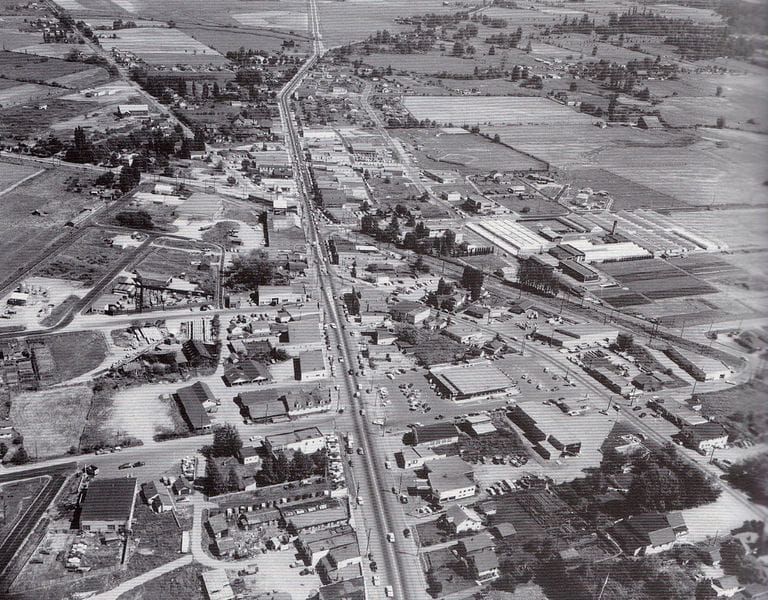
Langley Prairie was the urbanizing core of the Township of Langley, the commercial and residential hub that had grown up over the first half of the twentieth century around the British Columbia Electric Railway, the Fraser Highway, and the Pattullo Bridge.
Originally a rural homesteading area known as Innes Corners, the district took on the name Langley Prairie in 1911 and developed steadily from there into the Township's main urban centre.
By the 1950s, while the surrounding Township remained farmland and small rural business hubs like Fort Langley, Milner, and Murrayville, Langley Prairie was something different: denser, more commercial, and in need of services the rural majority on Township council saw no reason to fund.
For more than a decade its residents had paid into the Township's tax coffers while watching their requests for that infrastructure get turned aside in favour of road grading and rural service.
The grievance that broke the proverbial camel's back was specific.
When Langley Prairie asked for streetlights, Township reeve George Brooks declared that "not a nickel" would be spent on them.
By the early 1950s, the urbanizing district was contributing roughly 20 per cent of the Township's tax base and getting comparatively little of the infrastructure it needed in return.
In September 1954, the area held a referendum on secession. More than 85 per cent of voters said yes. On March 15, 1955, Langley Prairie officially became the City of Langley.
The split happened because a community of urban residents and an outlying rural one had fundamentally different needs, and the urban community was being subordinated to the rural one within a single jurisdiction.
Seventy-one years later, that same demographic reality persists. Only the fiscal vectors have reversed.
Today, the leadership of the Township of Langley seems to want the two communities reunited. Township Mayor Eric Woodward has been making the case publicly since the fall of 2025, when he registered Progress for Langley as an elector organisation in both jurisdictions and in the school district.
He has framed the question civilly in some moments and uncivilly in others. The civil version is whether Langley residents are being well served by two municipalities. The uncivil version is that City of Langley politicians, in his words, "wouldn't last 10 minutes in the township."
City of Langley Mayor Nathan Pachal's response was direct. He has said he will not, in his phrase, "kowtow just because there's someone who's larger" wanting something.
The question Woodward asks is a legitimate one, and it deserves a serious answer rather than a defensive one.
So this article sets out to answer it.
The answer is grounded in three decades of Canadian academic research and direct case studies from Ottawa, Toronto, Halifax, Montreal, and right here in British Columbia.
Amalgamation has not delivered its promised cost savings anywhere it has been tried, and has often produced the opposite of what was promised.
It would impose costs on residents of both municipalities, with the heaviest fiscal burden falling on the City of Langley and the heaviest representational burden falling on the Township's outer rural and suburban communities.
Both communities have something distinct to lose.
What the law actually says
Before any of the evidence is weighed, the legal framework needs to be on the table, because it shapes everything else.
Under section 279 of British Columbia's Community Charter, titled "No forced amalgamations," two municipalities can only be merged into one if separate majority votes in each municipality both come back in favour. Neither Victoria nor the Lieutenant Governor in Council can override that requirement. The Union of BC Municipalities has affirmed this protection as a foundational element of municipal autonomy in the province.
What that means in practice is that any amalgamation requires the active consent of both communities.
The two municipalities cannot be merged without separate majority votes in each. A 51 per cent vote in the Township alone is not enough; the same threshold must also be met in the City. The decision belongs equally to both electorates, and either community can decline.
That has implications for how to read the current political moment. Progress for Langley has expanded into the City and the school district, the joint RCMP detachment has ended, and Township leadership has been publicly raising the question of whether the two municipalities should remain separate.
Together these developments potentially signal an active effort to build the political conditions for an amalgamation vote across both jurisdictions.
The question worth asking, before such a vote takes place, is whether the merger itself would be a good idea on the evidence.
The debt question, answered
Considering the current state of Langley politics, one plausible explanation for the renewed focus on amalgamation is the Township's fiscal trajectory.
According to Strong Towns Langley, a community advocacy group focused on fiscal sustainability, Township borrowing authorizations have grown from roughly $168 million before the 2022 election to over $668 million by early 2026, a fourfold increase in less than four years.
Township staff confirmed at the November 17, 2025 council meeting that the cumulative authorised debt total stood at $526.7 million, a figure that does not include borrowing through the Township-controlled Langley Housing Trust Society.
Independent financial analysis by Mike Parker at Langley Tomorrow, which incorporates the Housing Trust Society debt, puts total Township debt closer to $861 million.
The Township's remaining statutory borrowing capacity has dropped accordingly.
Under provincial law, a BC municipality cannot spend more than 25 per cent of its property tax revenue servicing debt. Langley Tomorrow has documented that the Township's remaining room under that liability servicing limit has dropped to approximately $166 million.
The major capital projects the Township has committed to deliver each carry price tags larger than that remaining room:
- The Willoughby Community Centre and pool has been estimated at $250 million.
- The performing arts centre has been estimated at $85 million by the Mayor's figure, and t $150 million or more based on comparable BC facilities.
Both Strong Towns Langley and Langley Tomorrow have flagged that the Township's current borrowing trajectory, combined with a stalling development cycle that may slow the development cost charge revenue used to service that debt, has created a meaningful fiscal squeeze.
In that context, the question of whether amalgamation could reset that debt is a fair one to ask.
The legal answer is no.
Under sections of BC's Local Government Act governing the issuance of letters patent for new or restructured municipalities, the Lieutenant Governor in Council can "allocate and assign or transfer" assets and liabilities, both real and contingent, in whatever manner the Council considers just and expedient.
In plain language: when two municipalities amalgamate, their assets and their liabilities transfer to the new combined entity. Debts do not vanish. They become the debts of the new municipality, serviced from the new municipality's combined tax base. Creditor consent is generally required for any reduction.
The functional consequence is more important than the legal one. The Township's per-capita debt burden would fall, because the burden would be spread across a larger combined population. Roughly 132,000 Township residents become 165,000 amalgamated residents. The same debt, divided across more taxpayers, looks lighter per household.
The City's per-capita debt burden, conversely, would rise.
City residents, who today carry a comparatively low municipal debt load, would inherit responsibility for a proportionate share of debt service that the Township incurred without their input or consent.
The $19 million the City spent on its Fraser Highway One-Way revitalisation, its largest self-funded project to date, would suddenly sit on a balance sheet alongside the Willowbrook road widening, the Smith Athletic Park, the Five Rinks at the Langley Events Centre, the fire halls, and other Township capital projects the City had no role in approving.
This is not speculative. It is what the Canadian case studies in this article document, most directly in Nepean, the fiscally disciplined Ottawa-area suburb that effectively subsidised the central city's prior debts after the 2001 amalgamation. It is also why the demerger municipalities in suburban Montreal voted to leave the moment the question was put to them.
They were not anti-government. They were protecting their own residents from being co-opted into financing the central city's prior decisions.
What residents and businesses actually pay, and what would change
The abstract argument about cost harmonisation becomes concrete when you look at what households in each municipality actually pay.
The figures below come from the province's annual "Taxes & Charges on a Representative House" report, compiled into a regional comparison by Langley City staff and released by Mayor Pachal in November 2025.
They measure municipal-controlled property taxes plus municipal utility fees together, which is the only fair way to compare, because percentage-based tax-increase headlines tell you nothing about the actual dollar figure a resident pays.
These are averages, so an individual household will pay somewhat more or less depending on its specific assessed value. Solid waste is excluded because service models vary too widely across the region to compare cleanly.
One structural fact shapes how the figures read. The two municipalities have different housing profiles. In the City, about 70 per cent of households live in apartments and townhouses and about 30 per cent live in detached homes. The Township is weighted more toward detached and ground-oriented housing.
Because the two communities are built differently, the comparison ought to be done housing type by housing type rather than as a single municipal average.
Apartments and townhouses (average per household)
| Municipality | Property Tax | Utility Fees | Total |
|---|---|---|---|
| Langley City | $1,353.94 | $854.14 | $2,208.08 |
| Langley Township | $1,480.47 | $1,549.16 | $3,029.63 |
For an apartment or townhouse, the Township total runs about $822 higher than the City total.
Most of that difference sits in utility fees: the City bills attached-housing owners $854.14, while the Township applies a flat utility fee of $1,549.16 that does not vary by dwelling type. The property tax portion is closer, with the Township about $127 higher.
Detached homes (average per household)
| Municipality | Property Tax | Utility Fees | Total |
|---|---|---|---|
| Langley City | $3,194.31 | $1,372.98 | $4,567.29 |
| Langley Township | $2,835.13 | $1,549.16 | $4,384.29 |
For a detached home, the totals are much closer, and the Township total runs about $183 lower than the City total.
Here the City charges about $359 more in property tax, while the Township charges about $176 more in utility fees because of the same flat fee. The two effects nearly cancel, leaving the Township modestly lower overall for this housing type.
Put together, the two tables show that the City and the Township each have categories where their residents pay less. The City is lower for apartments and townhouses. The Township is lower for detached homes. The flat versus consumption-based utility models are the main reason the comparison flips between housing types.
What would change under amalgamation
This is where the Canadian evidence becomes directly relevant.
Every amalgamation studied in this series produced the same pressure: wages, service levels, and fee structures tend to harmonise toward the higher-cost option within each category rather than the lower one, because no group of residents accepts a service downgrade and no union accepts a pay cut as the price of restructuring.
A merged Langley would have to choose a single property tax rate for each class, a single utility fee model, a single pay grid, and a single set of service standards.
The table below sets out the likely direction of each choice and who it would affect.
| Service component | Likely harmonisation direction | Effect |
|---|---|---|
| Utility fee structure | One model has to be chosen for the merged municipality | If the Township's flat fee wins, City condo and townhouse owners pay roughly $700 more per year in utilities. If the City's consumption-based model wins, Township detached owners and rural properties end up with higher bills for water and sewer use. |
| Residential property tax rate | The higher rate within each housing class becomes the new rate | For apartments and townhouses, the Township rate is higher, so City attached-housing owners pay more. For detached homes, the City rate is higher, so Township detached owners pay more. |
| Municipal staff wages and benefits | The higher of the two pay grids becomes the new pay grid | Whichever municipality currently pays its staff less brings those wages up to match. Total payroll rises for the merged entity, and every taxpayer in both former municipalities helps cover it. |
| Service levels (parks, snow clearing, road maintenance) | The higher service standard in each category becomes the new standard | Residents in whichever municipality currently receives a lower service level start receiving more, which is good for them, but the cost of providing those services across the larger combined area is paid by everyone. Township rural areas, which need more road and drainage per household, become more expensive to service when held to a higher standard. |
| Existing Township debt service | The full debt rolls into the merged municipality's budget | Township residents see their per-household share of the debt drop because it's spread across more people. City residents take on a share of debt service they had no vote in approving, paid through their property taxes going forward. |
The point of the table is not that any one group is singled out.
It is that amalgamation forces a single answer onto questions the two municipalities currently answer differently, and the documented tendency is for that single answer to be the more expensive one in each category.
A merged council cannot keep the City's consumption-based utility fees for some residents and the Township's flat fee for others indefinitely; it has to pick. It cannot run two pay grids for the same job titles; it has to harmonise. Each of those decisions has a winner and a loser among current residents, and the Canadian record shows the net effect raising costs rather than lowering them.
Businesses face the same kind of uncertainty.
The City currently draws roughly 51 per cent of its property tax revenue from residential property and the rest from commercial property and utilities, and it has committed in its economic development plan to holding its non-residential-to-residential tax ratio steady, a ratio the Langley Chamber of Commerce has asked the City to keep at no higher than 1:3.
The Township sets its own commercial ratios against a larger and more dispersed commercial and industrial base. A merged council would set one ratio for both. Whatever it chose, some businesses in one or both former municipalities would find the tax treatment they had planned around had changed, and that uncertainty carries its own cost for any business weighing whether to invest, expand, or stay.
None of this produces a single predicted dollar figure, because the outcome depends on choices a merged council has not made.
What the published rates and the Canadian case studies establish together is the direction of travel. Both municipalities currently operate tax and fee structures their own councils set for their own communities.
Amalgamation would replace two structures with one, and the consistent finding across Toronto, Ottawa, Halifax, and Montreal is that the combined structure costs more to run than the separate ones it replaced, while the savings used to justify the merger fail to appear.
What Township residents stand to lose
The case against amalgamation does not run in only one direction.
Township residents, particularly those outside the high-growth Willoughby corridor, face their own set of risks under any plausible merger.
The Ottawa example (discussed in detail below) provides an instructive parallel.
The pre-2001 outer municipalities (Goulbourn, Cumberland, Osgoode, Rideau, West Carleton) entered amalgamation as fiscally distinct rural and semi-rural communities with their own priorities, service expectations, and tax structures.
Twenty-five years on, those areas, now wards of the larger city, consistently report feeling underrepresented at council. Their road maintenance, drainage, agricultural support, and rural-specific service needs compete for council attention against the priorities of denser urban wards, and the urban wards usually win.
Goulbourn, which had the lowest pre-merger taxes in the region, saw essentially no benefit from the initial post-amalgamation tax reductions. Its residents now pay into a fiscal pool that funds capital projects and service standards calibrated to a much more urban centre.
The Township of Langley is not a single community.
It is a mosaic. Aldergrove, with its distinct downtown and long-standing identity, occupies its own place in Township politics. Fort Langley is a heritage village with a tourism economy and an architectural character that requires specific governance attention.
Walnut Grove, Willoughby, and Murrayville each have different demographics, different ages of housing stock, and different infrastructure cycles. Glen Valley, Otter, Brookswood, and the agricultural communities along the Agricultural Land Reserve have rural service needs that are not the same as urban service needs.
The Township council already has to balance all of those competing priorities. Adding the urban core of the City to that priority queue would not relieve the existing tensions. It would compress them further.
The geography of the merged entity would amplify the pressure.
The City of Langley is roughly ten square kilometres of dense, urbanising land directly adjacent to a SkyTrain station that begins service in 2029. Senior-government-led transit investment, downtown revitalisation, and Innovation District planning around Kwantlen Polytechnic University all concentrate considerable economic and policy interest in that compact area.
In an amalgamated entity, that area would, by simple gravity of investment, become a strong candidate for the new municipality's de facto centre of attention. Rural and outer-suburban Township communities, already further from the existing Township seat, would find themselves competing with a transit-oriented urban core for limited council time and capital budget.
The same dynamic that has played out for 25 years in outer Ottawa would play out here, and the Township areas furthest from the new centre would experience it first.
Any Canadian parallel to a merger that produced clear, demonstrable, durable benefits for the absorbed rural and suburban communities does not appear to exist.
Sancton, Novack, the Fraser Institute, IMFG, and AIMS have all looked.
The pattern observed in Ottawa, Toronto, and Halifax is consistent: outer communities lose representation, lose service customisation, and gain a share of an operating and debt burden calibrated to a different scale of urban governance.
Township residents are not standing on safer ground than City residents in this conversation. They are standing on different ground that produces a different set of risks.
The case for keeping the two municipalities separate is, on the evidence, a case for both.
The Canadian evidence
The pattern of what actually happens when Canadian municipalities amalgamate is unusually consistent across decades and provinces. The four cases most relevant to Langley are Ottawa, Toronto, Halifax, and Montreal.
Each produced different promises and different outcomes, but the through-line is the same: the savings used to justify the merger never appeared, costs rose, and the smaller and more fiscally disciplined partners ended up subsidising the larger ones.
Ottawa: the Nepean parallel
The Canadian case study that most closely tracks the Langley situation is Ottawa.
On January 1, 2001, the Mike Harris Progressive Conservative government dissolved the Regional Municipality of Ottawa-Carleton and 11 lower-tier municipalities into a single-tier City of Ottawa.
The amalgamated entities included the old City of Ottawa itself, which carried significant debt, and Nepean, a suburban municipality of about 130,000 residents that was so fiscally disciplined it had erected signs at its borders announcing "We're debt-free." Nepean's last mayor, Mary Pitt, has been on the public record for 25 years describing the merger in unambiguous terms.
"I think it's a failure," she told CBC News in December 2025, on the eve of the merger's 25th anniversary.
The transition board that engineered the amalgamation projected annual savings of $86.5 million and a workforce reduction of 1,100 positions. Neither materialised. Property taxes did fall briefly in the first year, by about ten per cent on average, but the cuts were uneven.
Goulbourn, with the lowest pre-merger taxes in the region, saw essentially no benefit. By 2004 taxes were rising again. The amalgamated city now carries debt approaching $3 billion and faces an annual transit operating shortfall approaching $140 million.
The mechanism by which Nepean's fiscal discipline was effectively neutralised is the same mechanism that would operate in a merged Langley. Reserves that had been built up by careful Nepean councils became reserves of the larger entity. Pre-existing debts of the old City of Ottawa became debts of the larger entity. Both sets of taxpayers became responsible for both sets of obligations.
Ottawa is not the exception. It is the rule.
Toronto: $300 million that never appeared
The Ontario provincial government promised, in 1998, that amalgamating the six municipalities of Metropolitan Toronto would save $300 million per year.
University of Western Ontario professor Andrew Sancton, the foremost academic authority on Canadian municipal consolidation, questioned that figure publicly at the time.
His reasoning was simple.
Labour compensation in the new entity would have to be harmonised upward to the level of the most expensive constituent municipality, because no union would accept a wage cut as the price of a political restructuring. Service levels would harmonise upward for the same reason: no community would accept worse service than it had previously enjoyed.
Costs would rise, not fall.
That prediction proved correct.
In a 1997 referendum across the six pre-merger municipalities, voters rejected the proposed megacity by margins ranging from 70 to 81 per cent. Harris forced the merger through anyway. Subsequent analysis by the City of Toronto's own staff documented the harmonisation effect on labour and service. City employment, which stood at 45,860 in 1998, had grown to over 50,600 by 2008. Toronto Star reporting in 2006 documented that the city's reserve funds had been depleted "despite promises amalgamation would save millions."
The amalgamated City of Toronto today struggles with infrastructure backlogs, transit funding shortfalls, and the political dynamics of a council in which suburban wards routinely outvote downtown ones on the issues most consequential to downtown residents.
Halifax: thirty years and no savings
The 1996 amalgamation that created the Halifax Regional Municipality (HRM) from the cities of Halifax and Dartmouth, the town of Bedford, and the rural county is now three decades old.
The provincial commissioner who designed it, William Hayward, projected over $20 million in annual savings. Sancton himself, looking back in April 2026 on the occasion of the anniversary, told CBC News there was "no evidence" the expected savings had materialised. Transition costs ran to roughly $26 million, well above the initial $10 million estimate.
A 2002 peer-reviewed study of HRM's police services found that amalgamation was associated with higher real-dollar costs, lower numbers of sworn officers, lower service levels, no real change in crime rates, and higher workloads for the officers who remained. Citizen surveys showed declining satisfaction with police service among those who had actually called the police, year over year, after the merger.
The HRM example deserves particular attention because it captures a piece of the Langley conversation that is often elided. Halifax's amalgamation was forced. There was no separate-majority safeguard equivalent to section 279. The province simply legislated it. As former HRM mayor and Nova Scotia's current Lieutenant Governor Mike Savage acknowledged, there was "no question" of backlash against the lack of consultation.
In British Columbia, that route is not available. The province cannot impose what the residents of either municipality refuse to consent to.
Montreal: the only major unwinding
The Montreal amalgamation of 2002 produced the only major Canadian example of partial reversal.
After the Parti Québécois government forced 27 suburbs into a single megacity, voter backlash brought in a Quebec Liberal government that authorised demerger referendums in 2004. Fifteen of the 22 island-of-Montreal municipalities that held votes met the dual thresholds of a yes majority and 35 per cent registered-voter turnout, and were reconstituted as separate municipalities on January 1, 2006.
The demerger story matters for two reasons.
The first is that voters, when given a meaningful choice, chose separation.
Westmount, Mount Royal, Dollard-des-Ormeaux, Pointe-Claire, Beaconsfield, and others all voted to leave. The pattern of which municipalities voted to demerge tracked closely with municipalities that had been fiscally well-managed before being forced into a merger with a less disciplined central city.
The second is that even the demerger was not a true restoration of pre-merger autonomy.
Under the Charest government's Bill 9, the reconstituted municipalities only received back specific local powers (garbage pickup, animal control, local streets, some cultural facilities). The expensive items (police, fire, main streets) remained controlled by an agglomeration council in which the central city's larger population gives it greater voting weight. The 14 reconstituted island municipalities now hold only 13 per cent of the votes on the agglomeration council.
A 2016 HEC Montréal study illustrated the spending pressures the merger model created. Between 2001 and 2005, average per capita spending in Longueuil, which the merger had tripled in size, grew 2.7 times faster than in the Quebec City urban community and 5.4 times faster than in the Montréal urban community itself.
The lesson Montreal teaches is that unwinding an amalgamation is profoundly harder than preventing one. The institutional gravity of a centralised structure does not release its captures readily.
The most reliable way to preserve a small municipality's autonomy is not to surrender it in the first place.
The British Columbia parallels
Two recent BC amalgamation efforts illustrate the same pattern the older Canadian case studies show.
In each, a community took the question seriously, commissioned formal study, and came out the other side without producing a merger.
Duncan and North Cowichan
Duncan and the District of North Cowichan are two adjacent communities approximately 50 kilometres north of Victoria on Vancouver Island.
In 2017, both councils commissioned a joint citizens' assembly to examine whether they should amalgamate. After several months of deliberation, the assembly concluded that any resulting savings would be "negligible." A 2018 referendum followed, and Duncan voters rejected the merger.
The lesson from Duncan and North Cowichan is precise. A formal, deliberative process examined the financial case for amalgamation and could not find substantial savings to recommend.
The community then decided, on the strength of that finding, that the merger was not worth pursuing.
Saanich and Victoria
Saanich and Victoria are the two largest municipalities in the Capital Regional District, and their amalgamation conversation has run longer, gone further, and just this week hit its most significant obstacle yet.
It is the most current and most directly relevant case available to Langley residents.
Both Saanich and Victoria first asked their residents in 2014 whether they wanted the amalgamation question explored. They said yes. In 2018, voters in each municipality approved spending $250,000 to establish a Citizens' Assembly on Amalgamation, with the province contributing another $250,000. From September 2024 to April 2025, 48 randomly selected Saanich and Victoria residents met for eight day-long sessions, putting more than 2,500 hours into deliberation. In April 2025, the assembly recommended that the two municipalities amalgamate.
That recommendation has now run into the same problem the academic literature would predict.
In April 2026, BC Housing and Municipal Affairs Minister Christine Boyle wrote to both mayors declining to authorise a binding referendum on the merger, citing outstanding questions about financial implications and the need for deeper consultation with area First Nations. On June 22, 2026, after months of effort to satisfy the province's concerns, Saanich council voted 7-2 to fall back to a non-binding opinion question for the October 2026 ballot.
The question Saanich and Victoria voters will see, "Do you support Saanich and Victoria becoming one municipality?", will carry no legal force. Saanich Mayor Dean Murdock acknowledged the outcome was not his preferred path, and noted that a no result from voters would end the project.
Two municipalities sharing a border in a major BC urban region asked the amalgamation question with full provincial and institutional support. They spent more than $750,000 on a deliberative process that drew international interest. They received a yes recommendation from their citizens' assembly.
And after the province examined what implementing that recommendation would actually require, it concluded the case had not yet been made on substance.
What both BC cases tell Langley
The lesson from these two BC cases is the same lesson the older Canadian case studies told.
The case for amalgamation has to hold up on its own financial and transitional substance.
It cannot rest on intuition, on the "common sense" framing that Mike Harris deployed to such damaging effect in Ontario, or on the observation that two municipalities sharing borders feels somehow inefficient.
Duncan and North Cowichan came to that finding directly through their citizens' assembly. Saanich and Victoria are reaching it now through the province's refusal to authorise a binding vote on what their citizens' assembly recommended. In neither case has thorough examination of the merger question produced a result that justifies proceeding.
It would be reasonable for residents of the two Langleys to expect at least the same standard of evidence before being asked to support a merger here.
Why the promised savings never appear
The pattern that emerges from the Canadian and British Columbia cases is so consistent that it has become a settled finding in Canadian local government scholarship.
Sancton's 1996 conclusion in Canadian Public Administration was unequivocal: "There is no academic evidence to suggest that consolidation produces savings."
That conclusion has held up across two decades of further research.
The Institute on Municipal Finance and Governance at the University of Toronto, Dalhousie's Jack Novack, the Atlantic Institute for Market Studies, and a 2015 Fraser Institute study by Lydia Miljan and Zachary Spicer have all reached the same finding. Novack put the academic consensus this way: all of the academic work demonstrates that amalgamation does not save money.
The Fraser Institute's review of three Ontario rural amalgamations between 2000 and 2012 found significant increases in property taxes, employee compensation, and long-term debt in both amalgamated and unamalgamated communities, suggesting no tangible benefit attributable to the merger.
The reasons are well understood.
The first is wage harmonisation. When two workforces are merged, the lower-paid employees demand parity with the higher-paid ones, and the higher-paid employees refuse to accept reductions. Compensation levels up to the higher figure, not the lower one. Because municipal expenditure is dominated by salaries and benefits, this single factor often eliminates any plausible administrative savings on its own.
The second is service harmonisation. Communities accustomed to higher service levels (more frequent garbage collection, better-maintained parks, faster snow clearing) do not consent to having those services reduced. Communities accustomed to lower service levels expect to be brought up. Service levels harmonise upward, and so do their costs.
The third is transition costs. Halifax projected under $10 million in one-time transition costs and incurred roughly $26 million. Ottawa's transition costs ran to approximately $189 million, of which the province covered $142 million and the new city $47 million.
The fourth is loss of competitive pressure between jurisdictions. The Atlantic Institute for Market Studies, in its review of consolidation in Atlantic Canada, captured this point cleanly. Multiple jurisdictions within a metropolitan area exert competitive pressure on each other to keep taxes low and service efficient, because residents and businesses can move between them. A consolidated monopoly faces no such pressure. The dynamic force that most reliably keeps municipal costs disciplined is not centralised bureaucracy but decentralised competition.
The fifth is bureaucratic growth. The City of Toronto entered amalgamation with 45,860 employees and reached 50,601 a decade later. The City of Halifax saw its first balanced budget only in the fourth year after amalgamation.
The sixth, and politically the most consequential, is the dilution of democratic responsiveness. Communities accustomed to direct access to their councillors lose that proximity. Issues hyper-local to one neighbourhood are decided by a council whose majority lives elsewhere and whose priorities are calibrated to different streetscapes, different demographics, and different needs.
This last point is where the Langley question turns from abstract to specific.
The human scale, and what it actually means
The argument for keeping the Langleys separate is not anti-density. The City of Langley is the dense one.
It is the SkyTrain-adjacent urban core, the walkable downtown, the place where Pacific Nazarene Housing Society is building affordable units around a SkyTrain station, where the Glover Road Innovation District Plan is preparing a transit-oriented employment zone, and where the Citizens' Assembly on community safety has just spent eighteen months developing a recommendation framework for resilient neighbourhood networks.
The City was built on roughly ten square kilometres of land. A resident of any part of it can reach any other part on foot, by bicycle, or by mobility scooter in a reasonable period of time.
The City is, by design and by geography, a human-scale municipality of the kind urban planners have spent decades trying to recreate elsewhere.
The Township covers over 300 square kilometres and ranges from urban Willoughby to suburban Walnut Grove to rural farmland in the Agricultural Land Reserve to the village of Fort Langley.
Those are different places with different needs and different politics.
Governing them under a single council has already produced predictable tensions. Adding the urban core of the City to that mix would not resolve those tensions; it would introduce a new set.
The "human scale" argument is therefore not about size in the sense of square kilometres or population. It is about the relationship between a municipality's residents and the council that governs them.
Small municipalities can know their constituents. Councillors can attend the neighbourhood meetings, can answer the phone, can walk the streets where the issues are being raised. When a council represents a population that lives within a coherent set of conditions and shares a coherent set of priorities, it can act with focus.
This is the insight that Vincent Ostrom and Charles Tiebout brought to political science in the 1960s, and that has been confirmed and re-confirmed by every careful Canadian case study since.
Multiple smaller jurisdictions with overlapping service partnerships consistently outperform single large jurisdictions on responsiveness, fiscal discipline, and the alignment of policy with local conditions. Sancton, looking back from 2026 on the Halifax experience, pointed to British Columbia's southern Vancouver Island and Gulf Islands as the ideal arrangement: municipalities retain their independence and local councils, while the Capital Regional District delivers services across the entire area.
That is, almost exactly, the model the two Langleys had before Woodward dismantled the joint RCMP detachment.
What the Langleys could do instead
Shared services without merger is not a hypothetical. It is the default arrangement throughout British Columbia, structured through the Local Government Act and operationalised through regional districts.
The Metro Vancouver Regional District already coordinates water, waste, parks, planning, and other functions across 21 member jurisdictions, including both Langleys, without those 21 jurisdictions losing their identities. The South Vancouver Island arrangement Sancton praised works the same way.
The City and the Township were operating a joint RCMP detachment as recently as 2025.
The decision to end it was Woodward's, on the stated rationale that the City's contribution did not match the time officers spent within City boundaries. There is a legitimate financial conversation to be had on that question, and any joint-service agreement can and should be reviewed for fairness.
But the choice between "amalgamate" and "operate in mutual hostility" is a false one. The middle path, which is the path most BC municipalities walk every day, is to share what makes sense to share and govern separately what is best governed close to home.
There is also a path the City might explore that has been quietly raised in the broader conversation about its identity.
The City and the Township sharing a name, when they are otherwise distinct municipalities with distinct economies and trajectories, creates real confusion. Residents of either community routinely refer to the other as "Langley" without specifying which. Visitors arriving on SkyTrain in 2029 will disembark at Langley City Centre Station and may have no idea that there is another Langley extending in every direction around them.
The City could, with a Council resolution and the formal process for municipal name changes under the Local Government Act, choose a name that more clearly signals its identity as a distinct urban centre. Names that reference its history, its First Nations heritage with appropriate consultation, its geography along the Nicomekl River, or its emerging character as a transit-oriented community could all be considered.
The decision would belong to City Council and ultimately to City residents, but the option exists, and clarifying the identity question through a rename could resolve much of what feels confusing about two Langleys without surrendering anything that the City has spent seventy-one years building.
There is also a possibility that the conversation about merging the two Langleys has not yet entertained, and that grows directly out of this article's opening history.
If Willoughby residents come to feel that their priorities and infrastructure needs are better aligned with the City of Langley than with the rest of the Township, the same path Langley Prairie took in 1955 remains open to them.
Willoughby is the Township's most urbanised community. It is geographically adjacent to the City. Its housing mix tilts toward townhouses, condominiums, and apartments, its demographics are younger and more diverse than the Township average, and the next phase of its growth is being calibrated around the SkyTrain extension arriving in 2029.
By every visible measure, Willoughby has more in common with the urban core of Langley City than with Fort Langley, Aldergrove, or the agricultural communities along the Agricultural Land Reserve.
The City, meanwhile, has spent seventy-one years building exactly the kind of compact, transit-oriented, walkable community that Willoughby's own master planning has been gesturing toward.
Two legal pathways exist. The simpler one, under section 15 of British Columbia's Local Government Act, requires a request from each of the two councils involved, the written consent of at least 60 per cent of the electors in the area proposed to be transferred, the assent of the broader electorate in both affected municipalities, and provincial approval.
That pathway is straightforward when the councils on both sides are willing partners, but it depends on Township Council agreeing to bring the question forward, which a Township Council opposed to the idea would very likely decline to do.
A second pathway, under section 8 of the same Act, does not require Township Council consent.
Under section 8(2)(d), the Minister of Housing and Municipal Affairs can direct that a vote be taken on a proposed change in local government for a defined area, on the Minister's own initiative, if the Minister concludes that it is in the public interest.
Under section 8(3), that vote can ask residents both whether they favour a change in their local government and, if so, whether they would prefer to be incorporated as a new municipality or included in an existing one.
This is the pathway that most closely mirrors what happened in 1954. Langley Prairie residents organised, made their case to the province, and the province directed the vote that produced an 85 per cent yes result. The legislative framework today is different in form but parallel in function.
A Willoughby movement that wanted to pursue either pathway could begin with informal polling of residents and a formal community petition. With Township Council on board, the petition could proceed under section 15 with the standard sequence of council requests, elector consents, and provincial approval.
Without Township Council on board, the petition could go directly to the Minister of Housing and Municipal Affairs with a request that the Minister direct a vote under section 8.
Either way, the City of Langley's willingness to receive the area would also have to be established, either by council resolution or by elector vote, depending on the specific structure chosen.
The 1955 precedent is relevant here. Residents of an urbanising area within a Township whose council was not serving their needs concluded in 1954 that the path forward was not for the Township to absorb the City, but for the urbanising area to redefine its own municipal home.
Seventy-one years later, the demographic mismatch that drove that decision has not disappeared, but it may have re-introduced itself within the Township's boundaries. Willoughby may very well now be where Langley Prairie was then.
The current conversation has framed amalgamation as the only structural change worth considering. It is not.
A boundary transfer that better matches Willoughby's demographic and developmental reality is an option that exists, and one its residents have the standing to explore on their own initiative.
Conclusion: the lessons of three decades, and one century
The City of Langley exists because the Township of Langley, in the 1950s, could not or would not serve the needs of an urbanising area that constituted a fifth of its tax base.
The City built itself, slowly and carefully, into the community that exists today: a walkable downtown, a SkyTrain station under construction, a Citizens' Assembly developing community safety policy, a development pipeline built around transit and affordability, an Innovation District planned around higher-paying jobs at Kwantlen Polytechnic University, and a downtown revitalisation just completed at $19 million in self-funded infrastructure.
In 2026, the Township of Langley is asking whether the two municipalities should remain separate. The stated reasons vary by audience. The unstated mathematics of the situation favour the Township's position considerably more than they favour the City's.
The Canadian evidence on what would actually happen is overwhelming, consistent, and decades deep. Amalgamation does not save money. Amalgamation costs money.
Amalgamation harmonises wages and services upward, raises transition costs, dilutes democratic responsiveness, eliminates the inter-jurisdictional competition that disciplines local government, and consistently transfers fiscal burdens from the larger and less disciplined partner to the smaller and more disciplined one.
It also reliably dilutes the political voice of the outer rural and suburban communities that get absorbed into a larger urban council.
In Langley's case, the smaller and more disciplined partner is the City. The outer communities most at risk of losing their voice are in the Township. Neither municipality's residents would be made better off by a merger.
That does not mean the two Langleys cannot work together. It means the path forward is not absorption.
It is the same path that has worked across Metro Vancouver, across Greater Victoria's southern Gulf Islands, and across most of the country. Share what makes sense to share, in transparent and fair arrangements. Govern separately what is best governed close to home. Honour the 1955 decision that gave the City its existence and the seven decades of careful work that have built it into what it is, and honour the Township's own communities in their distinctness.
Anything else would be a step backward toward the same conditions, and the same posture, that produced the 1955 secession vote in the first place.
The Township mayor who said "not a nickel" would be spent on Langley Prairie's streetlights set a tone the rest of the century corrected for. There is no reason to repeat the experiment in 2026.
The evidence has been clear for thirty years. It is no less clear here.
References and Further Reading
Academic and policy literature
- Andrew Sancton, "Reducing costs by consolidating municipalities: New Brunswick, Nova Scotia and Ontario," Canadian Public Administration, 1996.
- Andrew Sancton, "Merger Mania: The Assault on Local Government," McGill–Queen's University Press, 2000.
- Lydia Miljan and Zachary Spicer, "Municipal Amalgamation in Ontario," Fraser Institute, 2015.
- James C. McDavid, "The impacts of amalgamation on police services in the Halifax Regional Municipality," Canadian Public Administration, 2002.
- Dale Poel, "Citizen Responses to Municipal Consolidation," Canadian Journal of Regional Science, 2000.
- Peter Trent, "The Merger Delusion: How Swallowing its Suburbs Made an Even Bigger Mess of Montreal," McGill–Queen's University Press, 2012.
- Robert Schwartz, "Toronto Ten Years after Amalgamation," 2009.
- "Amalgamation or Decentralization," Institute on Municipal Finance and Governance, University of Toronto.
- "Ten years after the municipal demergers: in the end, who is benefiting from the reform?" HEC Montréal, 2016.
News reporting and analysis
- "25 years after Ottawa's amalgamation, is there any going back?" CBC News, December 31, 2025.
- "Ottawa at 25: The Amalgamation That Never Delivered," The Rowanwood Chronicles, December 2025.
- "Stuck with the Suburbs," The Leveller, February 2023.
- "It's been 30 years since amalgamation of the Halifax Regional Municipality. Was it a success?" CBC News, April 2026.
- "Victoria, Saanich to work on amalgamation question for next municipal election," CBC News, July 2025.
- "The Long Quest to Merge Victoria and Saanich Hits a Roadblock," The Tyee, June 2026.
- "Amalgamation question for Saanich voters to be non-binding, after province weighs in," Times Colonist via Castanet, June 23, 2026.
- "Victoria-Saanich Citizens' Assembly on Amalgamation," official project website.
- "BC's 2026 Municipal Election Hot Spots," The Tyee, October 2025.
- "Comment: Amalgamation can't fulfil cost-saving promise," Victoria Times Colonist, July 2016.
- "Fix Governance 1: Municipal Amalgamation Didn't Really Work. Here are 3 Responses," Fix Your City, May 2024.
Local Langley reporting and primary financial analysis
- "War of the Langleys: governance tensions between township and city mayors spills into the open," CBC News, September 2025.
- "Why Langley Township's $600M debt is city hall's biggest debate," CBC News, April 2026.
- "Township budget passes after acrimonious council meeting," Langley Advance Times, March 2026.
- "City of Langley completes $19M downtown revitalization," CBC News, September 2025.
- Mike Parker, "Did the Township of Langley Borrow $177M Without Authorization?" Langley Tomorrow, February 2026.
- Mike Parker, "The Willoughby Community Centre Is Mathematically Dead" Langley Tomorrow, February 2026.
- Strong Towns Langley, "Financial Sustainability Analysis," ongoing.
- Strong Towns Langley, "A $144 Million Crack in the Township of Langley's Financial Strategy," December 2025.
- Strong Towns Langley, "How Volunteers Spotted a $64.5M Problem and The Township Didn't," December 2025.
- Strong Towns Langley, "Council Meeting Summaries," ongoing.
Comparative tax and fiscal data
- "Langley City tax rate among the lowest, municipal numbers show," Langley Advance Times, November 2025.
- Nathan Pachal, "Comparison of Metro Vancouver Municipal Property Taxes and Utilities in 2025," The South Fraser Blog, November 2025.
- Nathan Pachal, "2025 Data Shows Langley City has the Third Lowest Property Taxes & Utility Fees for Detached Homes in Metro Vancouver," The South Fraser Blog, August 2025.
- Nathan Pachal, "April 25th Council Notes: Property Tax Mill Rate. Amendments to the Financial Plan," The South Fraser Blog, April 2022.
- Nathan Pachal, "Langley City 2026 Resident Property Tax Increasing Under $100," The South Fraser Blog, April 2026.
- Nathan Pachal, "New Economic Development Plan for Langley City: Be. Enterprising," The South Fraser Blog, December 2024.
- "City of Langley 2026 Draft Budget Proposed with 5.82% Property Tax Increase," Langley Chamber of Commerce, November 2025.
- "Langley City's 2026 Financial Plan Puts Residents and Businesses First," City of Langley, January 2026.
Legal and governance framework
- Community Charter, section 279 (No forced amalgamations), Province of British Columbia.
- Local Government Act, Division 1 — Municipal Incorporation Process, Province of British Columbia.
- Union of BC Municipalities, "No Forced Amalgamations" resolution.
- Province of British Columbia, "Municipal restructure."
- Province of British Columbia, "Municipal incorporation and classification."
- Province of British Columbia, "Local government boundary changes."
- Province of British Columbia, "Municipal Boundary Extension Policies Guide," March 2010.
- Wikipedia, "City of Langley, British Columbia."
What did you think?
Help us improve! Take a quick 60-second survey to share your thoughts on this article.
Take the Survey