
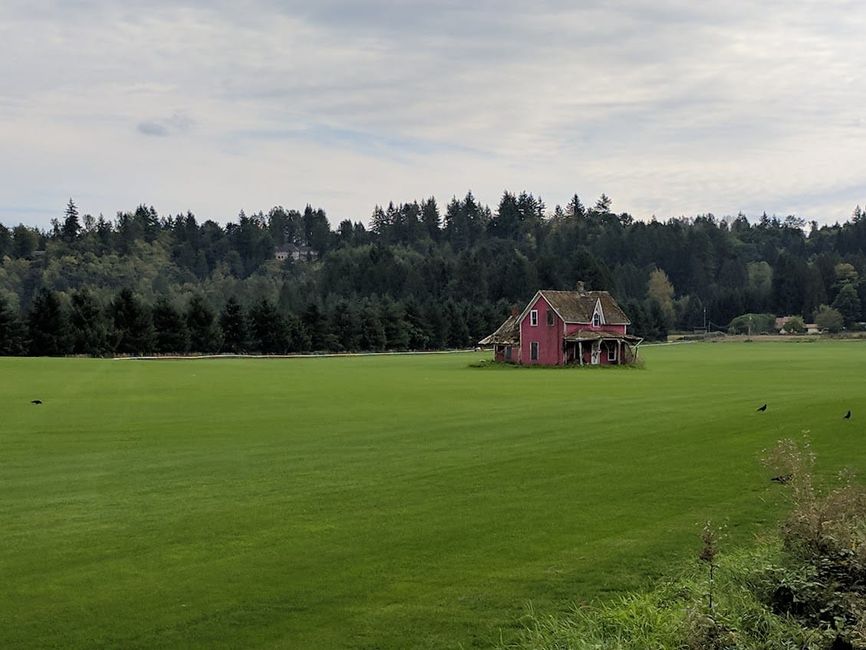
The Little Red House burned in the dark.
Township of Langley fire crews were called just after midnight on Thursday, August 27. The first truck arrived to find the house already fully alight. About 20 firefighters and five trucks worked the scene. Nobody was hurt. By daylight there was ash in the grass at 8258 252 Street in Glen Valley, and a gap where a farmhouse had stood for almost 140 years.
Most people knew the place as a shape. Red walls. A steep gable. A dormer window. A verandah across the front. All of it sitting alone in a sea of green turf. It was the house you slowed down for.
But a house is not a shape. A house is a collection of stories from the lives of the people who lived their lives under its roof.
These are some of those stories.
Like what you are reading?
The Langley Union runs with no ads, no paywalls, and no sponsored content. Only readers like you keeping it going.
Leave a one-time tipThe ground it stood on
Murdoch McIver arrived in Glen Valley in 1876 and homesteaded 160 acres, about 65 hectares.
That land was not empty. Glen Valley sits on the traditional territory of Stó:lō peoples, including the Kwantlen, Matsqui and Katzie, who lived along this stretch of the Fraser for thousands of years before a surveyor drew a line through it. The colonial land system that let settlers claim and clear ground was closed to the people already here.
That is the ground the Little Red House stood on. Saying so takes nothing away from the McIvers. It just keeps the story honest.
Murdoch and Annie
Murdoch McIver was born in Scotland. His name appears in the records as both McIver and McIvor, and as both Murdoch and Murdock, which tells you something about how records were kept back then.
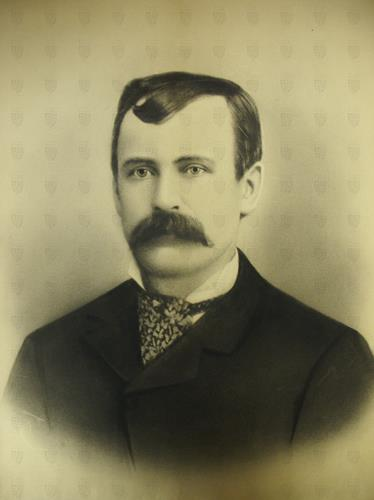
His first years on the property were hard in the ordinary way of those days. He built a log cabin. He cleared stumps. He made yokes for oxen. He logged and he fished, because the farm on its own did not pay.
In 1880 he went to work for the Canadian Pacific Railway as a blasting foreman. In 1884 he leased the Fort Hotel and ran the bar there for about a year and a half. This was a man doing four jobs to hold onto a piece of land.
In 1886 he travelled to Sherbrooke, Quebec. On November 4 he married Annie McIver, who was no relation. They came back west to the cabin together.
Then the survey crew arrived. The McIvers learned their cabin was sitting in the right of way of a road that had not been built yet.
So Murdoch moved the house. He hauled the cabin up to the 8200 block, where it stood into the 1990s, and let the road come through.
For a time that road was called McIvor Road. Today it is 252 Street. Every driver who ever slowed down to look at the red house was on a road named for the man who built it.
The house they built for nine kids
The cabin was too small, on account of the nine children they had.
So between 1887 and 1890 they built the house everyone came to know. It went up in the Carpenter Gothic style, the fashionable look for a farmhouse of that era. A steep front gable. A dormer window. Decorative brackets. A full open verandah running the width of the front.
Carpenter Gothic was a settler's version of a grand idea. It borrowed the pointed, vertical lines of stone cathedrals and reproduced them in cheap milled lumber, on a farm, by people who were not architects. That is exactly why the Little Red House looked the way it did. Ambitious and homemade at the same time.
Murdoch did not stay a private man either. He served as a municipal councillor and a school trustee, and he founded the Langley Agricultural Association.
Think about what that means. The same person cleared the stumps, built the house, sat on council and started the farm organization. Glen Valley in the 1890s was small enough that one family could be all of that at once.
The McIvers also sold land as they went. In 1890 they subdivided and sold 80 acres, about 32 hectares, to the Allen brothers. The 160 acre homestead was already coming apart into the parcel map we live with today.
The Kirks
In 1927 the McIvers decided to move to Fort Langley.
They sold the house and 40 acres, about 16 hectares, to Edwin and Maude Kirk. The remaining 40 acres went to their son, Kenneth McIver.
The Kirks lived there for 16 years, until 1943.
We know almost nothing else about them, and that is worth sitting with for a second. Edwin and Maude Kirk raised whatever life they had inside those walls for the better part of two decades. The archives hold their names, the year they arrived and the year they left. Everything in between is gone.
Most of the people who passed through that house are like the Kirks. They are a line in a file. The house outlived the memory of them, and now the house is gone too.
The quiet century
After 1943 the record thins out further.
What is clear is that the building kept working. It was still occupied through the early 1990s, and by all accounts it was kept in good condition the whole time.
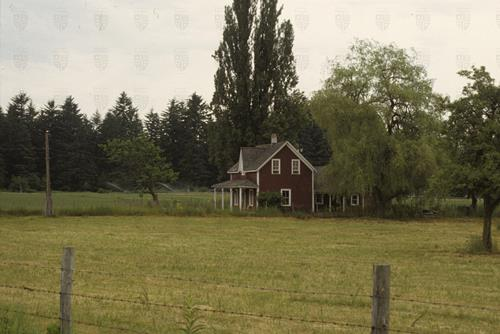
That is the part people forget when they look at the photos from the last few years. For roughly a century, the Little Red House was not a landmark. It was somebody's kitchen. Somebody's cold hallway in February. Somebody's front steps in the rain.
It only became a picture after it stopped being a home.
The stories it started collecting
The land changed hands, and the farming around it changed with it. By 2010 the house was empty and surrounded by a turf farm.
That is when it started collecting a different kind of story.
For a century the Little Red House held the stories of the families inside it. After that it began holding the stories of everyone who went past. Those stories are smaller and they belong to far more people, and by the end there were thousands of them.
There are the pumpkin patch stories. Aldor Acres sits directly across the road, and for a generation of Lower Mainland families an October afternoon there is a fixed ritual. The hay ride. The animals. A kid hauling a pumpkin far too heavy to carry.
The red house sat in the background of all of it.
It is in the corner of thousands of family photos that were never about the house at all, taken by parents who could not have named it and would still recognise it instantly.
Albert Anderson farms at Aldor Acres and watched the traffic build for years. "It was a motorcycle stop," he told the Langley Advance Times. Riders pulled over. Drivers pulled over. Somebody always seemed to be standing there with a camera.
There are running and riding stories. Ask anyone who trains on the flat roads of Glen Valley and you will hear the same thing. The red house was a waypoint.
People added a kilometre or two to a route just to go past it. It was the turnaround on a long run. It was the thing you pointed at when a friend asked where the ride went.
On a road network with almost no landmarks, it was the landmark.
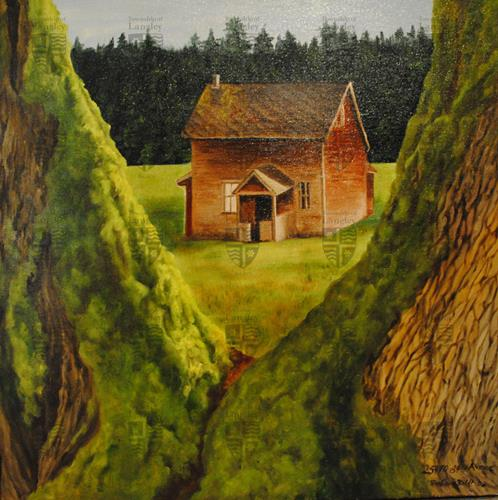
There are the photographers and the painters. An empty red farmhouse alone in a flat green field is close to a perfect picture. The Langley Heritage Society described it as one of the most photographed houses in Langley.
A Lower Mainland photographer who shot it in 2016 and 2017 wrote after the fire that he would miss driving past. He added something worth taking to heart: photograph the places you love now, because the ones most worth shooting are often the ones about to go.
There are stories about what could have been. Wally Martin owns the Princess and the Pea Hotel in Murrayville, and its Traveller's Hotel went up in the same period, built by early settlers in a similar style.
He said the Traveller's was in worse shape in 1997 than the McIver house ever was. It was restored anyway, and it still operates as a hotel today.
There was a version of the Little Red House that got to be an old building people walk into, rather than one they photograph from the shoulder of the road.
And then there is my own story.
I am an immigrant. When you move to a new country, you learn the practical things first. How to get around. How to get a bank account and a credit card. How to mentally convert Fahrenheit to Celcius (spoiler: it's impossible).
It takes much longer to learn what a place feels like to the people who grew up in it. Which quiet landmarks they miss when they are away. Which old buildings they slow down for.
The Little Red House was one of the first buildings in Langley I learned to slow down for.
It was not spectacular. It was not on a poster. It was a small, tired, beautiful building standing on its own in a green field, and it had been standing there since the Township was not yet twenty years old. Nobody made a fuss about it. It was just there, quietly holding nearly 140 years, and people slowed down for it because they loved it.
That taught me something about this place. The history here is often quiet. You have to go looking for it. The beauty in the Fraser Valley is not always the kind that shows up on a postcard. It is flat fields and long sight lines and old buildings people have driven past their whole lives. And a life can be built in a country where a farmhouse on a back road matters to thousands of people who never once set foot inside it.
I never went inside it either. I don't think that mattered.
The last years
The house did not fail all at once.
The front verandah collapsed when its supports gave way. A wire fence went up around the building to keep people out. The paint faded, but the red held, which is part of why it kept photographing so well right to the end.
The property is owned by Rob Rindt, a Township of Langley councillor and the general manager of Western Turf Farms, the family business that farms the surrounding fields. After the fire, Rindt called the loss heartbreaking. He said the building's deteriorated condition and the cost of restoration had made saving it unrealistic, and he invited people to post their photos, paintings and memories of the house. Many did.
Langley RCMP said the day after the fire that nothing at that stage suggested the blaze was suspicious. Rindt noted that a group of young people had reportedly been seen near the house not long before it burned, and said that was a matter for the RCMP and fire investigators.
The Langley Heritage Society said it was "sad and unfortunate" that the house was never preserved.
What is left
More than you would think.
salishan Place by the River holds the file. There is a photograph of the McIver house taken in June 1982, looking north, from a time when it was still a home. There is a written history that follows the property from a log cabin in 1876 to the fire in 2026.
There are also thousands of photos in private hands, which is unusual. Most heritage buildings are lost with a handful of grainy municipal pictures and nothing else. This one was photographed over and over, by strangers, for free, because it was beautiful and it was right there beside the road.
Every one of those photos is a story the house was holding for somebody. If you have one, it is now part of the record. Send it to the Langley Heritage Society or to salishan Place. A house that carried that many stories should not end up with a thin archive.
The house is gone. The stories and the memories live on.
What did you think?
Help us improve! Take a quick 60-second survey to share your thoughts on this article.
Take the Survey