

Table of Contents
Author's note: This article is dedicated to the memory of Catherine O'Hara, a Canadian icon and proud LGBTQ+ ally.
She made us laugh. She made us feel loved. She used her fame and her voice to make the world a kinder and friendlier place.
Her faith was quiet and generous, rooted in family, humility, and care for others.
Moira...Mrs. McCallister...Catherine, thank you.
You will be dearly missed.
The best way to help The Langley Union grow is simple: share this newsletter. Forward it to a friend, mention it to your family, or post it on social media and encourage others to subscribe.
On an unseasonably warm January evening in Cloverdale, Conservative MP Tamara Jansen gathered about 600 people at Hillside Christian Church to rally opposition against proposed changes to Canada's hate speech laws.
The January 23 event focused on Bill C-9¹, federal legislation that would remove a Criminal Code exemption allowing people to claim "good faith" religious expression as a defense when charged with willfully promoting hatred.
The gathering brought together multiple Conservative MPs, including Langley Township-Fraser Heights representative Tako Van Popta², Marc Dalton, and Ontario's Andrew Lawton, to express alarm about what Jansen characterized as threats to "religious freedom".
According to Jansen, attendees "came from many different faiths, diverse backgrounds, and various political stripes" united by concern that the bill would "punish peaceful Canadians for their beliefs."
What Jansen and her fellow MPs conspicuously failed to mention is that the "good faith" exemption they're defending has never once been successfully used (or necessary) to defend legitimate religious expression in a Canadian court³.
This isn't because religious Canadians are constantly skating the edge of hate speech prosecution and getting saved by this provision at the last moment.
It's because Canadian courts have never targeted legitimate religious expression in the first place.
The robust constitutional protections under Section 2(a) of the Charter, combined with the extraordinarily high legal threshold for what constitutes "hatred" (detestation and vilification, not mere disagreement or offense), already ensure that sincere religious teaching remains protected.
The exemption is redundant precisely because the legal framework already works.
Meanwhile, hate crimes targeting people based on sexual orientation increased 69% between 2022 and 2023 alone⁴, with crimes against gender-diverse people up 151% since 2020.
A Loophole That Doesn't Actually Protect Religious Freedom
Here's the profound irony of Jansen's crusade: the exemption she so vehemently defends has never successfully protected a single instance of legitimate religious speech.
Additionally, the Canadian legal system has gone out of its way to define "hate" in a way that intentionally protects the opinions of conservative anti-LGBTQ faith groups, such as Focus on the Family (though many Canadians might still identify their speech as "hateful").
In other words, the legal persecution Jansen claims is imminent has no basis in reality.
Not a single religious Canadian has ever needed this exemption's protection, because legitimate religious expression was never at risk.
By keeping this provision in the Criminal Code, Parliament isn't protecting religious Canadians.
It's painting a target on their backs.
The mere existence of Section 319(3)(b) codifies into law the insulting premise that, generally speaking, religious belief is so inherently adjacent to hatred that practitioners need a special carve-out in hate crime legislation.
It tells the world that faith communities require legal permission to exist because it implies that the regulation of hate crimes might pose an existential threat to their survival.
This is worse than unnecessary. It's a slander against every Canadian of faith and it's embedded into our legal framework.
The Criminal Code section⁵ at issue, 319(3)(b), currently states that no person shall be convicted of willfully promoting hatred "if, in good faith, the person expressed or attempted to establish by an argument an opinion on a religious subject or an opinion based on a belief in a religious text."
Courts have consistently rejected attempts to use this provision as cover for hatred.
In the 2001 case R. v. Harding³, involving a pastor who distributed anti-Muslim materials, the judge ruled that religious expression "cannot be used with impunity as a Trojan Horse to carry the intended message of hate." The defendant was convicted.
Every subsequent attempt to invoke this defense has failed. Justice Minister Sean Fraser⁶ noted the government is "unaware of any case where it's been used to acquit someone accused of hate speech."
Legal experts across the political spectrum acknowledge that Canadian courts have carefully prevented the provision from becoming a shield for bigotry disguised as theology, meaning that the government has never once weaponized the legal system to prosecute good faith theology as hate speech.
So what exactly is Jansen fighting to preserve? If this exemption has never protected sincere religious expression, who benefits from keeping it on the books?
The answer is clear: only those who want to maintain the fiction that authentic religious practice requires legal protection from hate speech laws.
Religious Freedom Doesn't Need a Hate Speech Loophole
The argument that removing Section 319(3)(b) threatens religious freedom reveals either profound ignorance of Canadian constitutional law or deliberate dishonesty about how Charter protections actually work.
Canada's constitutional protection for religious freedom is anchored in Section 2(a) of the Charter of Rights and Freedoms¹⁶, which guarantees "freedom of conscience and religion" as a fundamental freedom.
Unlike the hate speech exemption Jansen is defending, Section 2(a) actually protects religious Canadians. It does so comprehensively, robustly, and with decades of successful legal precedent behind it.
Section 2(a) protections extend to the freedom to hold and manifest religious beliefs, and freedom from state-imposed religion or coercion in matters of conscience.
Courts have upheld these protections in cases involving religious dress codes, healthcare decisions, workplace accommodations, prayer breaks, religious holidays, and conflicts between religious beliefs and institutional policies.
These aren't theoretical protections.
Provincial and federal human rights codes¹⁷ create positive obligations for employers and service providers to accommodate religious practices to the point of "undue hardship," a threshold courts have set fairly high. Minor inconvenience or cost isn't sufficient to deny accommodation.
The Real Question: What Are We Willing to Tolerate?
Yes, removing Section 319(3)(b) removes one layer of explicit statutory protection. Critics are right about that. As the Supreme Court noted in R v Keegstra¹⁸, the defence helps "make the scope of wilful promotion of hatred more explicit," signalling that genuine religious expression won't be swept into the offence.
Its removal may create some uncertainty for those "engaging in borderline cases."
But here's the question those critics refuse to answer: borderline cases of what, exactly?
What religious expression sits so close to the legal threshold of "detestation and vilification" that it requires a special exemption from hate crime legislation?
The Supreme Court has defined "hatred" narrowly and specifically, which serves as a hard limit on the potential for future weaponization of hate crime legislation to attack religious practice.
In Saskatchewan (Human Rights Commission) v. Whatcott¹⁹, the Supreme Court emphasized that only expression "likely to expose a person or persons to detestation and vilification" meets this threshold.
Ordinary religious expression, even expression others find offensive, doesn't qualify. Religious Canadians remain free to argue that certain behaviors are sinful or immoral.
What they cannot do is willfully promote detestation and vilification of identifiable groups.
If your sincere religious practice requires you to skirt that close to promoting hatred, maybe the problem isn't with hate speech laws.
Religious freedom in Canada has never been absolute. It's subject to Section 1's "reasonable limits" clause, which allows governments to justify restrictions that are demonstrably necessary in a free and democratic society.
Courts apply the Oakes test to determine whether limits on religious freedom are proportionate to legitimate government objectives.
This is not new. This is not persecution. This is how rights function in a pluralistic democracy where multiple freedoms must coexist.
A Faith Perspective on Protecting the Vulnerable
As a proud Mennonite Christian, I will gladly accept whatever minimal uncertainty the removal of Section 319(3)(b) might create if it also enhances the security of the most vulnerable members of our community. The trade-off isn't even close.
Hate crimes against LGBTQ+ Canadians have increased 388% since 2016⁴. Young people are being attacked for their identities. Families are being torn apart. Communities live in fear.
Meanwhile, there is not a single documented case of a Canadian being wrongly convicted of hate speech for genuine religious expression.
The "chilling effect" critics warn about is hypothetical. The violence against queer and trans people is statistical fact.
My faith tradition teaches that we are called to protect the vulnerable, to stand with the oppressed, to choose solidarity with those society marginalizes.
The gospel I follow doesn't require a legal loophole in hate speech legislation to express itself.
If it did, it wouldn't be worth following.
When the Supreme Court struck down parts of Saskatchewan's hate speech law in Whatcott, it did so precisely to protect religious expression. The Court ruled that prohibiting speech that "ridicules, belittles or otherwise affronts the dignity of" people was unconstitutional because it swept too broadly.
What remained was a carefully calibrated standard: detestation and vilification. That's the line. That's where hatred begins.
If religious practitioners can't stay on the right side of that line, the problem isn't the line. It's what they're teaching.
The Legal Protections That Actually Matter
So when Jansen warns that removing the hate speech exemption will criminalize religious expression, she's either unaware that religious freedom already has robust constitutional protection, or she's counting on her audience not knowing the difference.
The Charter protects sincere religious belief and practice. Courts still require prosecutors to meet the extraordinarily high threshold of proving willful promotion of detestation and vilification. The remaining statutory defences, truth and public interest, still apply. Any prosecution must still survive Charter scrutiny under Section 1 analysis.
The legal framework is clear: genuine religious expression is protected by Section 2(a) of the Charter.
The exemption Jansen is fighting for adds nothing to the protection of legitimate religious practice. It only muddies the waters by suggesting that authentic faith might reasonably include promoting hatred of identifiable groups.
Religious Canadians deserve better than being used as political props in a culture war that insults their traditions by implying they need special permission to avoid committing hate crimes.
And LGBTQ+ Canadians, many of whom are themselves people of faith, deserve a legal framework that prioritizes their safety over the hypothetical concerns of those who think sincere religious belief might accidentally cross the line into willful promotion of hatred.
That's not a difficult choice. It's the only choice consistent with both the Charter's protection of religious freedom and its fundamental commitment to human dignity and equality.
Faith and Queerness Aren't Incompatible
Thankfully, there are many Langley churches that openly embrace their LGBTQ+ neighbors and members.
For example, United Churches of Langley⁷ operates an Affirming Ministry team dedicated to educating the congregation on supporting queer people and other minorities.
As one congregant wrote, "This is the church that I've found in Langley where Queer people are welcome not only to sit in the pews and hide, but to openly participate in leadership as our whole selves."
Religious communities like United Churches of Langley demonstrate that faith and LGBTQ+ inclusion aren't incompatible.
Beyond Langley, queer Christian musicians like Grace Baldridge (stage name "Semler") and Spencer LaJoye challenge the narrative that authentic Christianity requires rejecting LGBTQ+ identities.
In February 2021, Semler's EP "Preacher's Kid" reached #1 on the iTunes Christian chart¹³, making her the first openly queer artist to top the Christian music charts. The album, recorded at home on a USB microphone and promoted entirely through TikTok, dethroned Lauren Daigle's "Look Up Child".
Later that year, Semler's second EP "Late Bloomer" also hit #1¹⁴, and in 2023, their single "Faith" charted #1 during Pride Month¹⁵.
The daughter of an Episcopal priest, Semler grew up listening to contemporary Christian music from bands like Relient K and Switchfoot.
"I grew up in the rectory," Semler told Religion News Service¹⁶. "I was raised in an accepting environment. But even that didn't spare me from outward church culture."
The success of "Preacher's Kid" was driven by a grassroots social media campaign among LGBTQ-affirming Christians and ex-Christians who recognized their own stories in Semler's vulnerable songwriting about being cast out in the name of God.
Spencer LaJoye, a nonbinary musician with a theology degree¹⁷, makes what they call "queer indie folk music for everyone."
Their 2021 anthem "Plowshare Prayer" went viral and has been adapted into commissioned choir pieces performed in Presbyterian and United Church of Christ congregations across the United States.
LaJoye's performances at "theaters, listening rooms, church sanctuaries, backyards, folk festivals, spiritual conferences, and queer clubs keep diverse audiences laughing one moment and weeping the next."
As Religion News Service noted¹⁸, "their music dares to posit questions some church folks are hesitant to speak aloud."
These artists represent a growing movement of LGBTQ+ Christians reclaiming faith on their own terms. Their success demonstrates that there's a hunger for honest, vulnerable expressions of faith that don't require erasing queer identity.
As Semler put it in an interview with NPR¹⁹, "I think once I embraced my queerness as not a burden but as a divine gift, it really opened up everything for me about how I understand divinity."
The existence of thriving queer Christian artists topping mainstream Christian charts demolishes the lie that faith communities must choose between theological integrity and LGBTQ+ inclusion. They can have both. Many already do.
Religious Canadians deserve better than being used as political props in a culture war that insults their traditions by implying they need special permission to avoid committing hate crimes.
And LGBTQ+ Canadians, many of whom are themselves people of faith like Semler and the congregants within the United Churches of Langley, deserve a legal framework that prioritizes their safety over the hypothetical concerns of those who think sincere religious belief might accidentally cross the line into willful promotion of hatred.
The Numbers Don't Lie
While Jansen mobilizes church congregations to defend a legal provision that has never once protected religious expression, actual human beings are experiencing actual violence.
Statistics Canada data⁴ shows hate crimes motivated by sexual orientation increased from 176 incidents in 2016 to 860 in 2023.
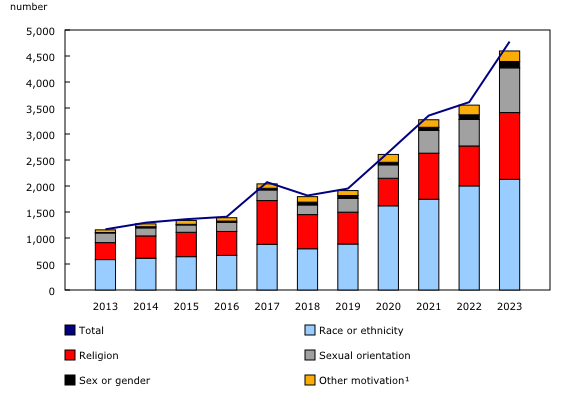
That's a 388% increase.
Crimes targeting gender identity or expression more than doubled between 2020 and 2023, reaching 123 incidents. And these numbers represent only reported crimes that police classify as hate-motivated.
Advocates note that many victims never report, fearing retaliation, discrimination from law enforcement, or simply not believing the system will help them.
The violence isn't abstract.
In 2023, 80% of hate crimes targeting gender-diverse people involved violent attacks.
What Bill C-9 Actually Does
The Combatting Hate Act¹ would create new Criminal Code offences including bans on displaying hate symbols like Nazi insignia or ISIS flags, prohibitions on intimidating people from accessing places of worship, and a standalone hate crime offence when any crime is motivated by hatred based on identity.
Attorney General Sean Fraser describes the nature of bill C-9
The bill would also remove the requirement for consent from provincial Attorneys General to proceed with hate propaganda charges, allowing law enforcement to act more quickly.
Critics worry this could enable politically motivated prosecutions, though supporters note that charges would still need to meet the high legal threshold of "willful promotion of hatred" defined as "detestation or vilification."
Most controversially, the Bloc Québécois negotiated removal of the "good faith" religious exemption as their price for supporting the bill.
Liberal Justice Minister Sean Fraser⁶ agreed, arguing the change "will in no way, shape or form prevent a religious leader from reading their religious texts. It will not criminalize faith."
This brings us back to the central question: if legitimate religious expression is already protected, and the exemption has never successfully defended anyone in court, why are Jansen and her colleagues fighting so hard to keep it?
Choosing Sides in the Culture War
The answer has little to do with protecting religion and everything to do with political positioning.
Conservative MPs are mobilizing religious voters by presenting Bill C-9 as an attack on faith rather than what it actually is: a measured response to surging hate-motivated violence.
Jansen's town hall exemplifies this strategy.
By packing a church with concerned congregants and invoking the language of persecution, she transforms a discussion about hate crime enforcement into a referendum on whether Christians can practice their faith freely.
Never mind that the overwhelming majority of Christian denominations in Canada have no interest in promoting hatred and would never run afoul of hate speech laws.
The strategy works because it exploits legitimate concerns about government overreach while obscuring the real-world consequences of inaction.
It's much easier to mobilize voters around abstract threats to religious liberty than to acknowledge that your political advocacy has material impacts on marginalized people's safety.
Consider what Jansen is actually asking for. She wants to preserve a legal framework that signals to hate-motivated actors that religious institutions might offer safe haven for their views.
She wants to maintain the perception that faith-based objections to LGBTQ+ existence deserve criminal law carve-outs, even though no court has ever agreed.
She wants to keep fighting battles about conversion therapy and "lesbian activity" while hate crimes surge to record levels.
The Choice Before Parliament
When Bill C-9 returns to the House of Commons following the committee process, MPs will face a straightforward question.
Do we prioritize a never-used provision that suggests faith requires legal cover for hatred, or do we protect marginalized communities facing a documented 388% increase in hate crimes?
Jansen has already shown which side she'll choose.
Meanwhile, young queer and trans people across Canada will continue navigating a landscape where attacks on their identity have increased nearly 400% in less than a decade.
Some of them will be people of faith, trying to reconcile their spirituality with the reality that MPs like Jansen use religion to protect legal exemptions for hate propaganda and violent crime.
Some of them might even attend United Churches of Langley⁷ or other affirming congregations in our community, experiencing firsthand that faith communities can embrace rather than exclude them.
On January 26, the House of Commons Justice Committee paused work on Bill C-9 to focus on bail reform legislation. Jansen called this "a welcome reprieve" while insisting "Bill C-9 remains flawed."
The real flaw isn't in the bill.
It's in the moral calculus that prioritizes protecting a symbolic gesture toward "religious freedom" over protecting actual human beings from actual violence.
Jansen's town hall made that calculus clear: when forced to choose between defending a legal provision that is not necessary for protecting religious freedom and defending her marginalized neighbors and constituents from a rising tide of hate-motivated violence, she chose the abstraction.
The people gathered at Hillside Christian Church that unseasonably warm Thursday night may believe they're defending religious liberty.
What they're actually defending is the social permission structure that makes hatred seem like a matter of conscience rather than what it is: hatred, full stop, regardless of which book you quote while expressing it.
References
- Government of Canada. (2025). Bill C-9: An Act to amend the Criminal Code (hate propaganda, hate crime and access to religious or cultural places). Parliament of Canada.
- Parliament of Canada. (2025). Tako Van Popta - Member of Parliament for Langley Township—Fraser Heights. House of Commons of Canada.
- The Globe and Mail. (2025, December 12). Canada's hate speech laws don't need a rewrite. They need to be enforced.
- Statistics Canada. (2025, March 25). Police-reported hate crime in Canada, 2023.
- Government of Canada. Criminal Code, Section 319. Justice Laws Website.
- CBC News. (2025, December 10). Liberals back Bloc's proposal to remove religious exemption from hate speech laws.
- United Churches of Langley. Queer Community | Our Vision and Principles.
- Wikipedia. (2025). Tamara Jansen.
- Government of Canada. Canadian Charter of Rights and Freedoms, Section 2(a). Justice Laws Website.
- Canadian Human Rights Commission. Canadian Human Rights Act.
- Supreme Court of Canada. (1990). R. v. Keegstra, [1990] 3 SCR 697.
- Supreme Court of Canada. (2013). Saskatchewan (Human Rights Commission) v. Whatcott, 2013 SCC 11.
- Religion News Service. (2021, February 10). LGBTQ singer-songwriter 'GameStops' Christian music with No. 1 Christian album on iTunes.
- Church Leaders. (2021, November 17). Grace Baldridge, 31-year-old openly queer Christian artist who goes by the stage name Semler, sat atop the iTunes Christian Albums chart for the second time in 2021.
- Church Leaders. (2023, June 30). Semler took to Twitter to celebrate the success of "Faith," which charted in the iTunes Store's Christian category.
- Religion News Service. (2021, February 10). Interview with Semler about Preacher's Kid.
- Spencer LaJoye. Bio.
- Religion News Service. (2023, June 29). A 'prophetic' force: Queer songwriter Spencer LaJoye finds resonance outside religion.
- Out Magazine. (2023, May 31). Chart-Topping Christian Artist, Semler, Wants You to Say 'Gay Rights'.
What did you think?
Help us improve! Take a quick 60-second survey to share your thoughts on this article.
Take the Survey