
Table of Contents
The best way to help The Langley Union grow is simple: share this newsletter. Forward it to a friend, mention it to your family, or post it on social media and encourage others to subscribe.
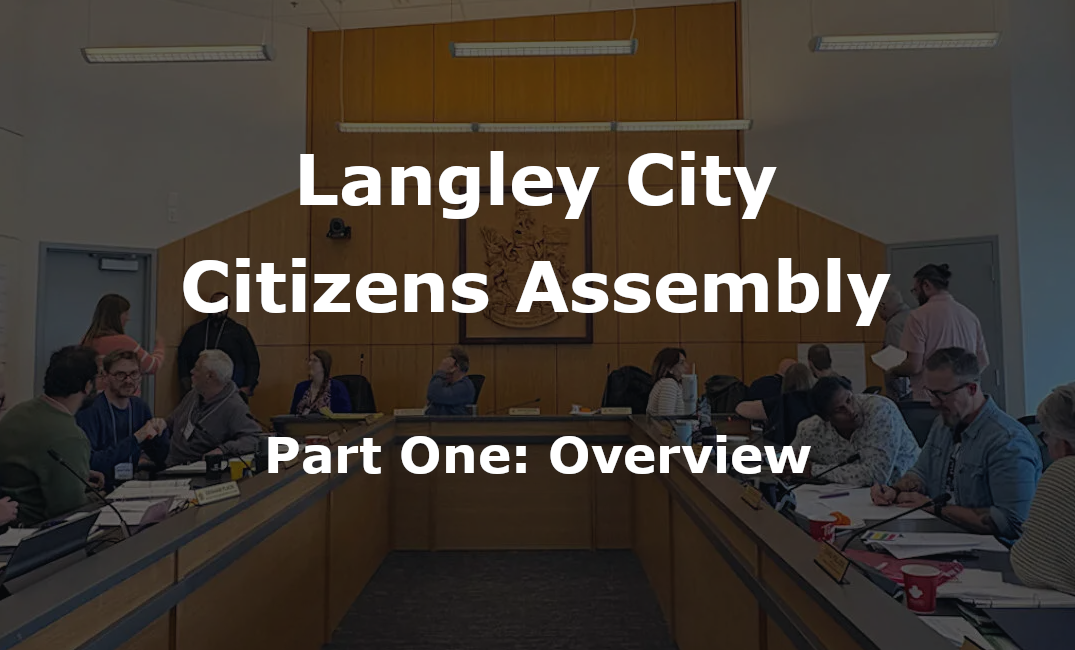
Twenty-nine randomly selected community members, including myself, spent months studying Langley City's community safety and wellbeing challenges.
The work of the Citizens' Assembly offers a model for how local democracy can actually work.
Citizens Assembly Public Presentation
Democracy has a participation problem
Most people never go to a city council meeting. Most people never fill out a public consultation survey. Most people, frankly, never get a real say in the decisions that shape their neighbourhoods, their streets, and their lives.
That is a central problem of local democracy, and it is not a new one.
The loudest voices at city hall tend to belong to the most organized, the most comfortable, and the most privileged.
Working people, renters, newcomers, people with disabilities, people struggling with housing instability or mental health challenges, parents who are overwhelmed with childcare responsibilities, the people whose lives are most directly shaped by municipal decisions, are the least likely to show up at a podium and speak for three minutes into a microphone.
Langley City Council decided to try something different.
In early 2025, council launched a Citizens' Assembly on Community Safety, Well-being, and Resilience.
Twenty-nine residents, business owners, and non-profit representatives were chosen through a civic lottery. They were not politicians. They were not lobbyists. They were your neighbours.
And they were asked to do something serious: learn about the most complex challenges facing this community, deliberate carefully, and deliver direct recommendations to council.
The result was a 57-page report, presented to council at its regular meeting on February 9, 2026.
It contains three core recommendations and four supporting ones. It represents months of listening, learning, and genuine community engagement touching more than 3,200 people across Langley City.
This is the first article in a series that will examine each of those recommendations in depth.
But before we get to the specifics of the recommendations, it is worth spending some time on the how, and the why.
What is a Citizens' Assembly?
A Citizens' Assembly is a group of randomly selected people brought together to study a specific issue, hear from experts, consult with the broader public, deliberate among themselves, and produce recommendations for government.
The process is structured to be representative, meaning it reflects the community in terms of age, gender, background, and perspective. It is also structured to be fair, meaning no single viewpoint dominates and all participants are given the same base of information.
The practice has deep democratic roots. Ancient Athenian democracy used a form of random civic selection called sortition, in which citizens were chosen by lot to serve on governing bodies. The idea was that true representation cannot be achieved through elections alone, because elections tend to select for those who already have power, resources, and name recognition.
In the modern era, the Citizens' Assembly has become one of the most promising tools in what researchers call deliberative democracy. The model gained international attention through Ireland's Citizens' Assembly, which met from 2016 to 2018 and produced recommendations that led directly to the historic 2018 referendum legalizing abortion in that country. France, the United Kingdom, and dozens of other countries have used assemblies to tackle issues ranging from climate change to electoral reform.
Here in British Columbia, the model has a proud history.
In 2004, British Columbia became the first government in modern history to give a randomly selected group of citizens the task of redesigning the province's electoral system.
The BC Citizens' Assembly on Electoral Reform brought together 160 randomly selected residents who spent nearly a year learning about voting systems before recommending a shift to Single Transferable Vote.
The recommendation ultimately narrowly failed in the required referendum threshold, but the process itself set an international standard for citizen deliberation and inspired similar assemblies in Ontario and beyond.
More recently, British Columbia municipalities have embraced the model. Burnaby used an assembly of community members to shape its Official Community Plan. The Town of Gibsons ran a five-day assembly on the same question. New Westminster has piloted a standing citizens' jury to advise council on a wide range of issues.
The OECD estimates that roughly half of the recommendations produced by deliberative processes of this kind are eventually implemented.
Why assemblies work
The appeal of the Citizens' Assembly is not just democratic idealism. There is a practical case for it, too, and it matters especially at the local level.
Ordinary public consultations are badly broken.
Satire from Parks & Recreation, with perhaps a kernel of truth, about the brokenness of public consultations and townhalls
If you have ever watched a Langley City or Township public hearing, you know what tends to happen: a handful of the same people show up, often organized property owners opposing a housing project, and their voices drown out the broader community.
Research consistently shows that renters and young people are sharply underrepresented in local public hearing processes, while a relatively small number of vocal opponents can dominate the proceedings and give decision-makers a skewed picture of what the community actually wants.
Citizens' Assemblies fix this through random selection.
Because participants are chosen from a broad pool rather than self-selecting, the room looks like the community. There are teenagers and retirees. There are business owners and renters. There are people who have never engaged in local politics before sitting beside people who attend every council meeting.
That diversity is not just symbolic. It changes the quality of the conversation.
Research out of Simon Fraser University and corroborated by the OECD shows that participants in deliberative mini-publics like Citizens' Assemblies make decisions that are less self-interested and more focused on the broader community good than participants in ordinary consultations.
In one BC example, more than 90 percent of Citizens' Assembly participants came away agreeing that people with different political beliefs can have civil, respectful conversations.
Another study found that more than 90 percent of Burnaby assembly members reported being satisfied or highly satisfied with the experience.
Perhaps most importantly, Citizens' Assemblies build public trust in outcomes. When people see that a recommendation came from a group of ordinary, randomly selected community members who spent months learning and deliberating, rather than from a politician or a developer lobby, they are more likely to accept it as legitimate, even if they might not have reached the same conclusion themselves.
This matters enormously for issues that are politically sensitive. Community safety, housing, and social services are exactly the kinds of topics where ordinary political processes tend to get captured by fear, partisanship, and bad-faith debate. A Citizens' Assembly, when properly designed, can cut through that noise.
How Langley City's Assembly was formed
Langley City Council launched its Citizens' Assembly as part of a council-endorsed priority to advance inclusive, collaborative, and data-informed governance.
The subject chosen was community safety, well-being, and resilience, specifically focused on reviewing and providing recommendations on the City's existing Community Safety, Well-being, and Resilience (CSWR) Policy Framework.
The City received 131 Expressions of Interest from residents. From that pool, 29 participants were selected through a civic lottery designed to reflect Langley City's diversity.
The group included residents from across the community: renters and homeowners, workers and business operators, people from a range of ages, backgrounds, and lived experiences. Non-profit representatives were also included to bring front-line knowledge of community needs.
The Assembly used the Challenge Dialogue System, a structured approach developed to help diverse groups tackle complex, value-laden issues through cross-sector collaboration, drawing from data, lived experience, and shared learning with City departments and community partners.
What the Assembly Did
The work was organized into six phases.
First, the Assembly developed a shared values statement and a member commitment to guide their process.
Values agreed upon included respect, inclusion, collaboration, learning, integrity, compassion, and courage.
Second, members undertook a learning phase with five sessions exploring each pillar of the CSWR framework, hearing from experts, City staff, and community partners.
Third came a listening phase, in which the Assembly engaged broadly with the community through forums, public dialogues, Solution Labs, and the Village Cafe Series.
That community engagement process was substantial.
The 2025 process built on 1,000 people engaged through Langley City's 2023 Restorative Community Dialogue.
In total, the Assembly's work and the parallel community engagement it relied upon touched more than 3,200 individuals who directly informed the learning, deliberation, and decision-making process.
The fourth phase was deliberation, where members tested big ideas through deliberation sessions, a Social Streets Initiative, and a local bus tour throughout Langley City to connect ideas to the physical realities of the city's neighbourhoods.
The fifth phase was decision-making, and the outcome should give every cynical observer of local politics pause.
The Assembly did not make decisions based upon majority votes. They reached consensus, which is a meaningfully higher bar.
It means that all seven recommendations brought forward to council carried the genuine agreement of all participating Assembly members, a group that was deliberately assembled to be diverse, to include voices that do not usually agree, and to represent a community far broader than the usual cast of speakers at a public hearing.
In an era when elected bodies routinely fracture along partisan lines over comparatively minor decisions, a randomly selected group of ordinary Langley City residents managed to find common ground on community safety, housing, mental health crisis response, and more.
That is not just a democratic success story. It is a pointed reminder of what becomes possible when process is designed around listening rather than winning.
The sixth and final phase is reporting and monitoring, with the recommendations now presented to council and moving forward for implementation.
What the Assembly produced
The Assembly's final statement captures both the process and its spirit. As their member statement reads:
"As members of Langley City's Citizens' Assembly, we came together as residents, workers, and neighbours to learn, listen, and collaborate across our differences.
Through this process, we learned that community safety is not only about enforcement or visibility, but about belonging, trust, housing, health, and communication.
We built understanding through evidence, stories, and experience, recognizing that safety and well-being depend on connection, prevention, and care.
Our recommendations reflect our collective voice and commitment to practical, compassionate, and data-informed action for a thriving, inclusive, and resilient Langley City."
The Assembly produced seven recommendations in total: three core recommendations and four supporting ones.
The core recommendations address Resilient Neighbourhood Networks, an Advocacy and Service Navigation Framework, and Balancing Community Safety Prevention and Visibility.
The four supporting recommendations cover Mobile Integrated Crisis Response, Housing as an Anchor, a Call for a Citizens' Assembly on Housing, and a Responsive Communication System.
These are not abstract policy papers.
They are practical, action-ready, community-driven proposals built on months of real conversation with the people who live and work in Langley City.
They reflect a community that is grappling seriously with issues of housing instability, mental health, social disconnection, and the limits of a law-enforcement-only approach to public safety.
And they represent a clear mandate from ordinary residents rather than from any political interest group.
A model worth expanding
The Langley City Citizens' Assembly is a relatively modest example of a model with significant potential at every level of government.
Citizens' Assemblies have been used at the federal level in Canada, including the Canadian Citizens' Assembly on Democratic Expression, which ran from 2020 to 2022.
Provinces could deploy them on contentious issues like electoral reform (again), pharmacare design, or land use planning.
At the municipal level, they are particularly well-suited for exactly the kinds of complex, emotionally charged questions that tend to get distorted by political grandstanding.
The OECD has identified representative deliberative models as having the potential to give agency to a much wider range of citizens, rebuild trust in government, and lead to more legitimate and effective public decision-making.
That is not a small thing in an era when trust in elected institutions is declining across the democratic world.
There are real limitations to the model, of course. Citizens' Assemblies can be resource-intensive to run well. Their recommendations are not binding, and history shows they can be ignored by the politicians who commissioned them. Their legitimacy depends heavily on how well the selection process reflects the actual community. And they cannot replace the hard work of sustained political organizing and civic pressure.
But when they work, as this one appears to have done, they represent something genuinely valuable: democracy practiced seriously, at the community level, by the people most affected by the decisions being made.
Coming up in this series
This article is the first in a series examining the full work of Langley City's Citizens' Assembly. In the weeks ahead, The Langley Union will publish in-depth looks at each of the Assembly's seven recommendations.
The three core recommendations to be examined are: Resilient Neighbourhood Networks, the Advocacy and Service Navigation Framework, and Balancing Community Safety Prevention and Visibility.
The four supporting recommendations to be examined are: Mobile Integrated Crisis Response, Housing as an Anchor, a Call for a Citizens' Assembly on Housing, and the Responsive Communication System.
Each of these recommendations has real implications for how Langley City spends public money, organizes community safety, and addresses the housing and social supports that the Assembly identified as the foundation of a healthy community. They deserve serious attention, and they are going to get it.
The Langley City Citizens' Assembly Direct Report to Council on Community Safety and Wellbeing was presented to council on February 9, 2026 at Langley City Hall. The full report is available through the City of Langley.
What did you think?
Help us improve! Take a quick 60-second survey to share your thoughts on this article.
Take the Survey