
.jpg)
Table of Contents
The best way to help The Langley Union grow is simple: share this newsletter. Forward it to a friend, mention it to your family, or post it on social media and encourage others to subscribe.
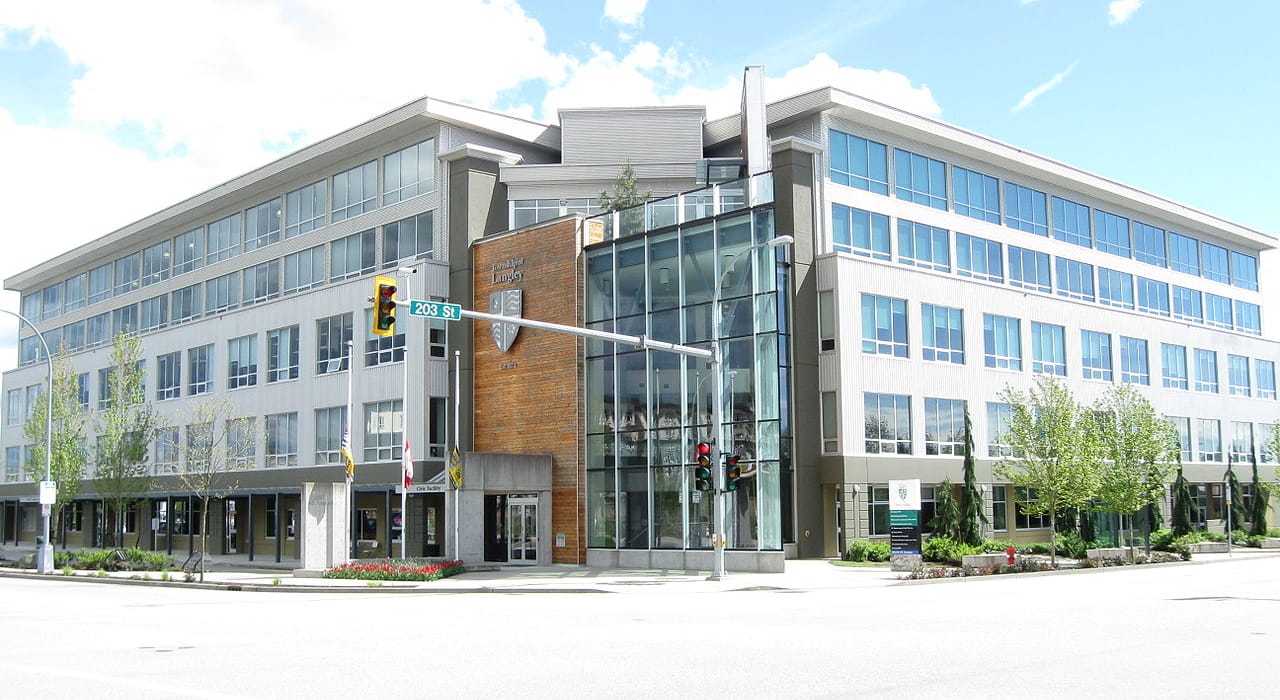
Langley Township Council has approved its 2026 budget, and the final vote tells you almost everything you need to know about where this municipality stands right now: five in favour, four against, split cleanly along factional lines.
Mayor Eric Woodward's Progress for Langley slate voted as a bloc to pass the financial plan.
All four independent councillors voted against it.
The debate lasted nearly two hours and got heated more than once. At the centre of it all: a 3.97% property tax increase, new public safety hires, and a growing pile of debt that nobody on council seems to agree on how to talk about.
For the average homeowner with a property assessed at $1.5 million, the tax increase means an extra $108.22 per year, or about $9 a month.
That breaks down to 1.59% for RCMP, 1.27% for fire services, 0.90% for core municipal services, and 0.22% for bylaw enforcement.
On its face, the increase is modest. The Township's property tax rates remain among the lowest in Metro Vancouver, a point Mayor Woodward has emphasized repeatedly.
What the budget buys
The biggest investments are in public safety.
The budget funds 16 new firefighters phased in between July and October, two new RCMP officers starting in December, three new bylaw enforcement officers, and a fire life safety educator.
These are real, tangible additions for a community that has grown rapidly and where survey respondents are alleged to have identified crime, policing, and transportation as their top concerns.
Township staff also identified $1.25 million in permanent cost savings through departmental efficiencies, with no impact on services. That is a meaningful find, and credit is due for trimming where trimming was possible.
New operating costs include $1.17 million for five months of running the Langley Events Centre's new ice and dry floor arenas, $109,000 for nine months of operating the new Brookswood Fire Hall #5, and $297,000 in insurance premiums tied to those new facilities.
An additional $2.9 million in debt payments covers culvert infrastructure and facility renewal borrowing approved last year. Revenue offsets include an anticipated $1.8 million increase from building permits, admission fees, and field rentals.
On the utility side, the news is actually good for multi-family residents. Sewer rates drop $173.60 per year and water rates drop $99.34, the result of a restructuring of flat-rate levies that Council directed in December 2025. Single-family homeowners see a small water increase of $18.40 and a sewer decrease of $66.13. Solid waste goes up $10 to $15 depending on bin size.
The water rate increase is driven by a 6.4% hike from Metro Vancouver for wholesale water purchases, though that is partially offset by the elimination of funding for the second phase of the Jericho Reservoir.
The debt picture
This is where the budget debate gets more complicated, and where the 5-4 vote starts to make sense.
Councillor Kim Richter pointed out during the debate that debt servicing in 2026 will cost $47 million, and the budget projects that figure could reach $64.2 million by 2030.
That makes debt payments the Township's third-largest expense, behind salaries ($129 million) and special contracts ($49 million). Councillor Blair Whitmarsh raised similar concerns, noting the debt appears to be "increasing quite significantly."
The five-year financial plan projects a 22.8% property tax increase for 2027.
Mayor Woodward has dismissed that number as a standard budgeting artifact, noting that last year's projection for 2026 was over 17% and the actual increase came in under 4%.
That is a fair point about how municipal five-year plans work. Budget projections that far out are often worst-case placeholders that get revised downward as actual revenues come in.
But the independent councillors are not the only ones asking questions. Community watchdog sites have been doing detailed, data-driven analysis of the Township's finances, and their findings deserve attention.
What the watchdogs are seeing
Langley Tomorrow, an independent commentary site run by Mike Parker, has documented that the Township's remaining borrowing capacity under its statutory liability servicing limit has dropped to just $166 million.
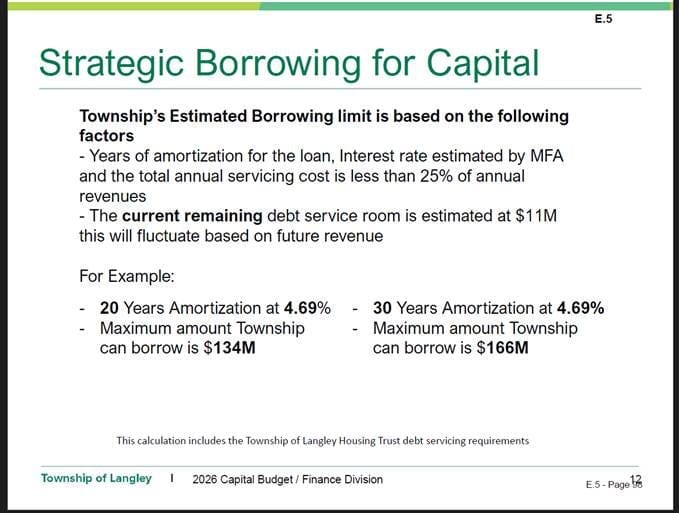
In British Columbia, municipalities cannot spend more than 25% of their property tax revenue on debt servicing. That ceiling is not a guideline. It is a hard legal cap.
The $166 million figure matters because the Township has promised residents several major facilities that each carry price tags larger than the available room.
The Willoughby Community Centre and pool has been estimated at $250 million. The performing arts centre has been pegged at anywhere from $85 million (the Mayor's figure) to $150 million or more (based on comparable facilities being built elsewhere in B.C.).
As Parker has noted plainly, 250 is a bigger number than 166.
Langley Tomorrow has also raised questions about $177 million in debt taken on through the Township of Langley Housing Trust Society, a wholly owned entity that partners with BC Housing to build affordable units.
That borrowing now appears consolidated into the Township's debt calculations in the 2026 capital budget, despite earlier public assurances that it would have no impact on borrowing capacity.
The timing of the change, Parker notes, followed a Section 172 complaint to the municipal auditor.
Strong Towns Langley, a community advocacy group focused on fiscal resilience, has tracked how Township borrowing authorizations have grown from roughly $168 million before the 2022 election to over $668 million.
That is a fourfold increase in less than four years. Much of that borrowing is tied to sports facilities and land purchases that depend on continued development revenue to pay off.
The growth gamble
The Township of Langley is one of the fastest-growing communities in British Columbia.
Growth is not optional for a municipality with this much undeveloped land and this many people arriving every year. You need fire halls, roads, sewer lines, recreation centres, and the police to keep it all safe. These improvements costs money, and borrowing is a normal part of how municipalities fund capital projects.
The question is not whether to borrow. The question is whether the pace and scale of borrowing is sustainable if the conditions that make it work change. The Township's own finance division listed debt servicing and interest rates as challenges in its budget report.
During the budget debate, councillors raised the question of whether a slowing pace of development would impact the Township's finances.
That is not a hypothetical concern.
Development charge revenue depends on building permits being pulled, which depends on developers seeing enough demand and favourable enough financing to keep building. Interest rates remain elevated. The Canadian dollar has been volatile. Tariff uncertainty looms over the broader economy.
If development slows significantly, the Township's financial model gets squeezed from both ends: less revenue coming in from new growth, and existing debt payments that do not shrink just because the economy does.
What residents should watch
None of this means the Township is in a financial crisis.
The 2026 operating budget is balanced. The tax increase is below inflation. Public safety is being resourced. Staff found real savings. Utility rates for multi-family homes are actually going down.
But the trajectory matters more than any single year's budget.
Debt servicing costs have been climbing steadily and are projected to keep climbing. Borrowing room is shrinking. Major promised facilities may not be buildable under current financial constraints.
It's also important to note that the budget passed on a party-line vote, which means the people closest to the numbers could not agree on whether this plan is the right one.
Residents who want to engage with this conversation should read the budget documents themselves, follow the independent analysts doing the math in public, and ask their councillors direct questions about which facilities are actually funded and which are still aspirational.
The Township's taxes are low. But in municipal finance, today's low taxes and tomorrow's debt payments are two sides of the same coin. What matters is whether both sides balance when the bill comes due.
References and Further Reading


 Matthew Claxton
 Matthew Claxton
Did the Township of Langley Borrow $177M Without Authorization?
What did you think?
Help us improve! Take a quick 60-second survey to share your thoughts on this article.
Take the Survey