
The best way to help The Langley Union grow is simple: share this newsletter. Forward it to a friend, mention it to your family, or post it on social media and encourage others to subscribe.
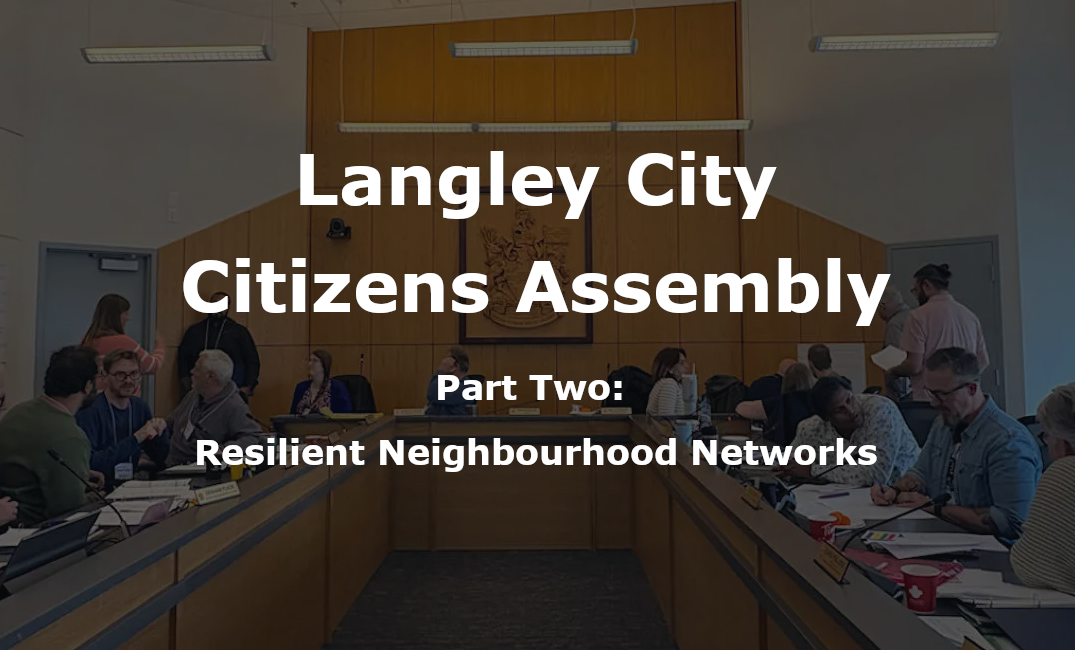
This is the second article in The Langley Union's ongoing series on the Langley City Citizens' Assembly on Community Safety, Well-being, and Resilience.
Read the first article, "Inside Langley City's Citizens' Assembly Experiment," for background on how the Assembly was formed and how it worked.
Public safety isn't just about what happens when things go wrong. It's also about what happens every other day of the year.
That's the core idea behind Resilient Neighbourhood Networks, the first of seven recommendations produced by Langley City's Citizens' Assembly on Community Safety, Well-being, and Resilience.
Council endorsed all seven recommendations on February 9, 2026 and pilots are set to launch in several Langley City neighbourhoods this year.
The idea is straightforward, even if the implications are significant.
Rather than relying entirely on police, fire, and emergency services to respond when a crisis happens, Resilient Neighbourhood Networks (or RNNs) are designed to organically build the kinds of relationships, skills, and trust that can make crises less likely, and can also make communities more capable when they do occur.
Safety means two different things to most residents.
First, it means being safe, meaning having access to services, resources, and a well-maintained public environment.
But it also means feeling safe by having a sense of connection, belonging, and trust in the people around you.
Neither one is enough on its own. And neither one can be delivered entirely by a government agency.
What Are Resilient Neighbourhood Networks?
The Assembly's recommendation calls on Langley City Council to endorse and activate RNNs as people-first neighbourhood hubs.
These hubs would weave together residents, local businesses, schools, cultural groups, Indigenous partners, first responders, and service agencies. The goal is to foster social connection and improve everyday safety, well-being, and emergency readiness.
In practice, this could look like recurring weekly free first aid training, certification, and roleplay sessions held at Timms community centre. It could be a monthly neighbourhood safety walk organized by residents and attended by local police/bylaw officers. It could be a recurring social gathering in a park to learn and perform basic bike maintenance, a cherished cultural event on a residential block, or a workshop on emergency preparedness during wildfire season.
The Assembly identified existing Langley City programs as proof of concept. Initiatives like the Village Cafe Series, Social Streets, and community forums have already shown that low-barrier neighbourhood gatherings increase inclusion, build trust, and help residents meet first responders in non-emergency settings.
RNNs are designed to build on and formalize what those programs have already demonstrated.
The City plans to form a Research and Action Team made up of Assembly members, community partners, and City staff to develop the framework.
The team will also create an "Residual Neighborhood Networks Toolkit" for neighbourhood volunteers, covering how to host events, navigate permits and grants, and access City facilities.
Pilots are expected to run in two to three neighbourhoods first, with outcomes reported back to Council at three, six, twelve, and eighteen months.
The Science Behind Resilient Neighbourhood Networks
The concept of Resilient Neighbourhood Networks is backed by a substantial body of research.
Studies consistently show that neighbourhoods with stronger social connections have lower crime rates, greater disaster resilience, and better mental health outcomes for residents.
Research published in peer-reviewed journals has found that people who report feeling more connected to their communities also report higher overall wellbeing.
One study found that social cohesion was one of the strongest predictors of how quickly communities recovered after natural disasters, with the effect being especially pronounced in lower-income neighbourhoods.
Research out of Amsterdam and published in BJPsych Open found that neighbourhood social cohesion factors, including safety, trust, and positive social connections, were linked to fewer depressive symptoms in young people.
A study in Scientific Reports found that community identity and social capital were key drivers of resilience during public emergencies.
The implication is clear.
Building neighbourhoods where people know each other, trust each other, and feel a sense of shared responsibility is not soft policy. It is one of the most evidence-backed investments a city can make in public health and public safety.
More Than Emergency Prep
One of the most exciting aspects of RNNs is what they could become over time.
Consider the range of skills that a well-supported neighbourhood network might offer its members. CPR and first aid certification. FireSmart training ahead of wildfire season. Extreme weather preparedness workshops. Food Safe certification for community event organizers. Neighbourhood emergency response training.
These are not just useful in a crisis. They are credentials. They are skills that carry genuine value in the workforce.
For a young person volunteering in their neighbourhood, CPR certification and event coordination experience are resume builders.
For someone re-entering the workforce, community leadership roles can open professional doors.
For a newcomer trying to build connections, a neighbourhood event is a low-barrier way to meet people and practice language skills in a welcoming environment.
The Assembly's report specifically highlights the intergenerational value of this kind of engagement. One Assembly member reflected on the experience of working side-by-side with younger members, describing the exchange of knowledge and personal growth that came from it.
That kind of cross-generational connection is exactly what RNNs are designed to cultivate.
There is also a mental health dimension that should not be overlooked. Social isolation is one of the most serious and underreported public health challenges facing communities like Langley City.
When people feel more visible, more connected, and more rooted in their neighbourhood, the data suggests they feel safer and they actually are safer.
A Timely Idea
This week, The Tyee published a piece by Peter MacLeod and Richard Johnson, authors of a new book called "Democracy's Second Act: Why Politics Needs the Public."
The article, adapted from the book, argues that democracies cannot afford to wait for a crisis to mobilize their citizens.
They point to Ukraine, where ordinary people came together immediately after the Russian invasion to sew camouflage nets, share emergency information, and organize community defence without waiting for direction from above.
They point to Canada's Syrian refugee response, where over two million Canadians participated in some form of resettlement support and where privately sponsored refugees integrated more successfully than government-sponsored ones, because the public brought its own networks and community connections to the work.
MacLeod and Johnson argue for what they call "civic challenges": structured, time-bound initiatives that invite governments to tap into the everyday capabilities of their citizens.
These are not vague calls for volunteerism. They are designed to solve real problems, build real skills, and create what the authors call a democratic dividend, leaving communities more prepared and more resilient than they were before.
Langley City's Resilient Neighbourhood Networks are, in many ways, exactly this kind of civic challenge.
They are structured. They are community-led. They are aimed at building genuine capacity, not just goodwill.
And they recognize something that both the Citizens' Assembly and MacLeod and Johnson's research affirms: governments are most effective not when they deliver solutions to citizens, but when they create the conditions for citizens to build solutions together.
What Comes Next
The RNN framework does not exist in isolation.
The Assembly's report makes clear that neighbourhood networks are meant to connect directly to the City's other recommendations, including the Advocacy and Service Navigation Framework and the Mobile Integrated Crisis Response model.
When a crisis is resolved on-scene, RNN connectors might provide local follow-up so that people do not fall through the cracks.
And here is the thing: you can get involved right now.
Langley City is currently accepting volunteer interest forms from residents, community groups, local businesses, service providers, and faith and cultural organizations who want to help shape how RNNs develop.
The application window is open until March 13, 2026. No prior experience is required.
The timeline from there moves quickly.
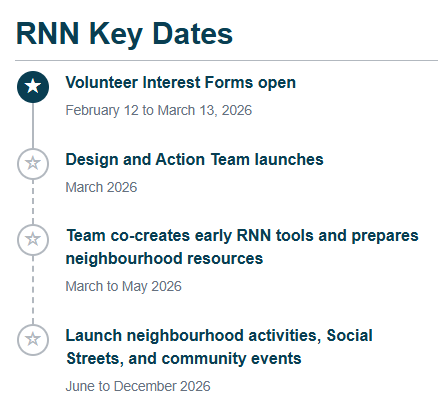
A Design and Action Team is set to launch in March, and will spend the spring co-creating early RNN tools and preparing neighbourhood resources.
By June, the first neighbourhood activities, Social Streets events, and community gatherings are expected to begin rolling out, running through the end of the year.
If you want to be part of building something that makes Langley City genuinely safer, not just in theory but on your street and in your neighbourhood, the volunteer interest form is available at letschat.langleycity.ca/safety.
Questions can also be emailed directly to CitizensAssembly@langleycity.ca.
In the meantime, the underlying message of RNNs is one worth sitting with.
Community safety is not only about enforcement or visibility. It is about belonging, trust, housing, health, and communication.
It is about people knowing each other well enough to notice when something is wrong, and caring enough to do something about it.
That kind of safety cannot be dispatched. It has to be built, one relationship at a time.
The next article in this series will examine the Assembly's recommendation for an Advocacy and Service Navigation Framework.
References and Further Reading

Click the link above for more information and/or to apply for the RNN Design and Action Team!
 Josefien J F Breedvelt
 Shuicheng Tian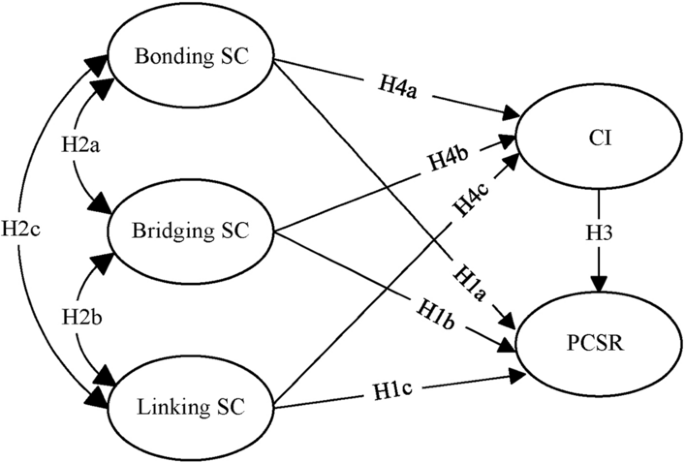
 Kathleen A. Cagney ,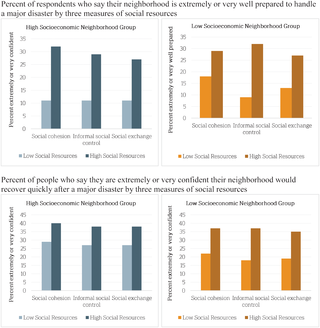
What did you think?
Help us improve! Take a quick 60-second survey to share your thoughts on this article.
Take the Survey